What the tune up visit covers
The tune up is a hands-on inspection with a short list of real adjustments. It is not a full repair visit, and it does not open spring hardware. Where a part is worn, the technician writes it up with a price and does the work right then if you want it done.
1. A look at springs, cables and drums
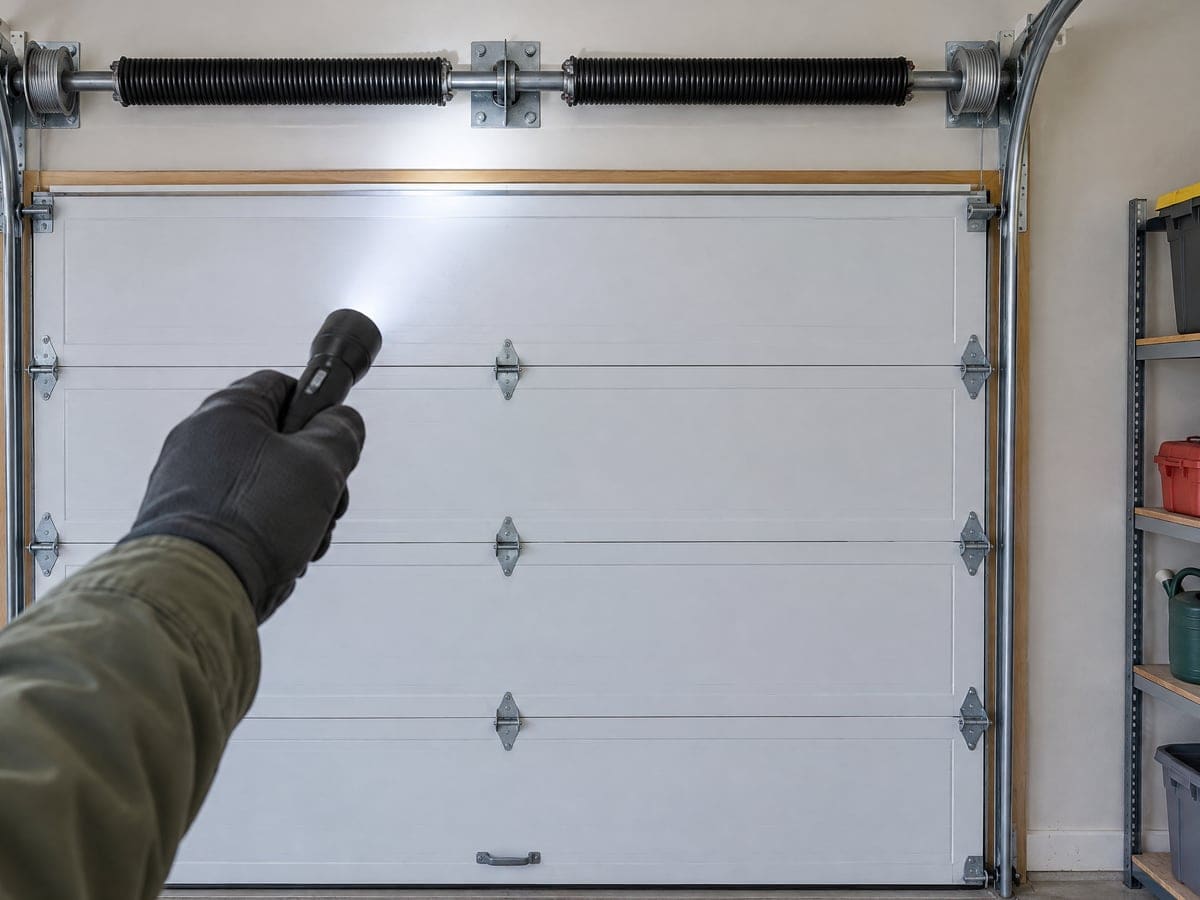
With the door closed and the opener's breaker off, the technician checks the torsion or extension spring for a gap in the coil, surface rust, and a tired look. The lift cables get a sight check for fraying, kinks and slack. The drums get a look at the set screws. Spring and cable work itself is not a tune up item; a worn spring found early becomes a spring repair on a visit of its own.
2. The balance check
With the opener disconnected at the panel, the technician lifts the door a few inches by hand and lets go. A balanced door holds in place. A door that falls has lost spring tension; a door that drifts up has too much. The balance check is a technician task because it works a door that is under load. We tell you where the balance landed and whether an adjustment is needed.
3. Rollers and hinges
Each roller gets a watch during one open and close, and each hinge gets a push and a listen. Flat spots, cracked wheels, bent stems and loose hinge screws all show on this pass. A tired set gets quoted; roller replacement often fits the same visit.
4. Tracks, fasteners and the jambs
The vertical and horizontal tracks get a sight down for dents, bows and loose brackets. The lag screws into the jamb get a snug. In an older garage with wood jambs, the technician checks whether the lag screws still have purchase or need longer replacements into fresh wood.
5. Lubricating the right parts
Hinges, roller stems and the coils of the springs get a non-greasy spring lubricant. The tracks stay dry on purpose, because grease on a track picks up grit and chews rollers. The opener's chain or belt gets a wipe and a thin re-lube only if the manufacturer calls for it.
6. Weather stripping and the bottom seal
The bottom seal and the side stops get a close look from inside. A torn end, a flattened middle or a brittle rubber all get called out. A fresh astragal often rides on the same visit; swapping a bottom seal is a short job that pays off through the first winter after it goes in.
7. Opener travel and force
With the opener back on, the technician checks the open and close limits and the force settings. A door that stops short or slams into the floor gets a small shift at the opener. A door that fights the hardware gets a note instead; the fix is at the door itself, not at the motor head.
8. Sensor and reversal checks
The photo eyes get a wipe and an alignment check. A length of 2x4 under the beam, the door closed from the wall, and the door should reverse off the block. A sensor that passes gets left alone. A fault here means sensor adjustments on the same visit.
| What we look at | What a problem looks like | What it usually needs |
|---|---|---|
| Springs | Gap in the coil, surface rust, drift on the balance check | Spring work on a later visit |
| Cables | Fraying, kinks, slack at a bottom corner | New cables in a pair |
| Rollers | Flat spots, cracks, wobble | A full set of rollers |
| Hinges | Loose screws, pin walking out | New screws or new hinges |
| Track and brackets | Dents, bows, loose lag screws | Straighten or replace, retighten |
| Bottom seal | Torn, flattened, split | A new astragal and retainer |
| Sensors | Dirty lens, bracket off true | Clean and realign, with the reversal test |
| Opener limits and force | Door slams or stops short | Limit and force adjustment |
When maintenance is enough and when a repair follows
When the tune up is the whole visit
A door with parts in good order comes out of a tune up running quieter and sitting on a seal that holds the floor dry. The next visit is a year away. Quieting a loud door is often a tune up outcome rather than a separate call.
When the tune up turns up a repair
A broken spring, a frayed cable, a bent track or a cracked bottom section is not a tune up item. If parts are on the van and the owner wants the work done that day, the repair runs on the same visit. For parts that need an order, we book the follow-up before leaving.
The repair sheet is read back to you at the opening and priced before any work goes in.
What our van carries on a tune up call
The van carries non-greasy spring lubricant, a full roller set in nylon and steel, standard hinges with longer screws for stripped jamb holes, a selection of bottom seal rubber with retainer, sensor pairs with brackets and low-voltage wire, flag brackets, lag screws in the common lengths, and the hand tools for the opener terminals and the drive gear. Most tune up visits do not need any of the heavier parts, but having them on the van means a worn roller does not become a second visit.
A tune up in a Barrington garage, start to finish
- You tell us the age of the door, roughly when it was last serviced, and whether anything has changed in the last few months. We book the visit.
- The technician arrives, kills the opener at the breaker, and goes through the eight checks above in order. The door is closed from the start of the look to most of the end.
- We walk you through what the inspection surfaced, what the opener needed, and what the repair sheet looks like if any part came up.
- The tune up closes with the breaker back on, two full cycles of the door while you watch, and a reversal test with an object on the floor.
Why fall is the right month to book a tune up in Barrington
Winter is hard on a door, so a tune up before the first freeze catches most of what the freeze would exploit. In the Chicago region, the normal first autumn temperature of 32 degrees or lower comes on October 19, and the normal last spring freeze comes on April 21. Cold contracts the steel, stiffens whatever grease is on the hardware, and leaves the rubber brittle enough to split under the opener.
The de-icer piles on. Barrington uses a mixture of salt and calcium chloride, with a liquid de-icer of salt brine, calcium chloride and a sugar-beet de-icer. The mix lands on hinges, cables and the bottom section through the winter, and the right time to rinse it off is after the last freeze. A spring visit after the salt season catches the parts that took the worst of it. Rinsing de-icer off the door covers the home side of that step.
A lot of Barrington garages have age on them. The median year built in Barrington village is 1971, so a garage with fifty years on it has more parts that benefit from a yearly look. Getting ahead of the cold covers the spring side of a cold-weather plan.