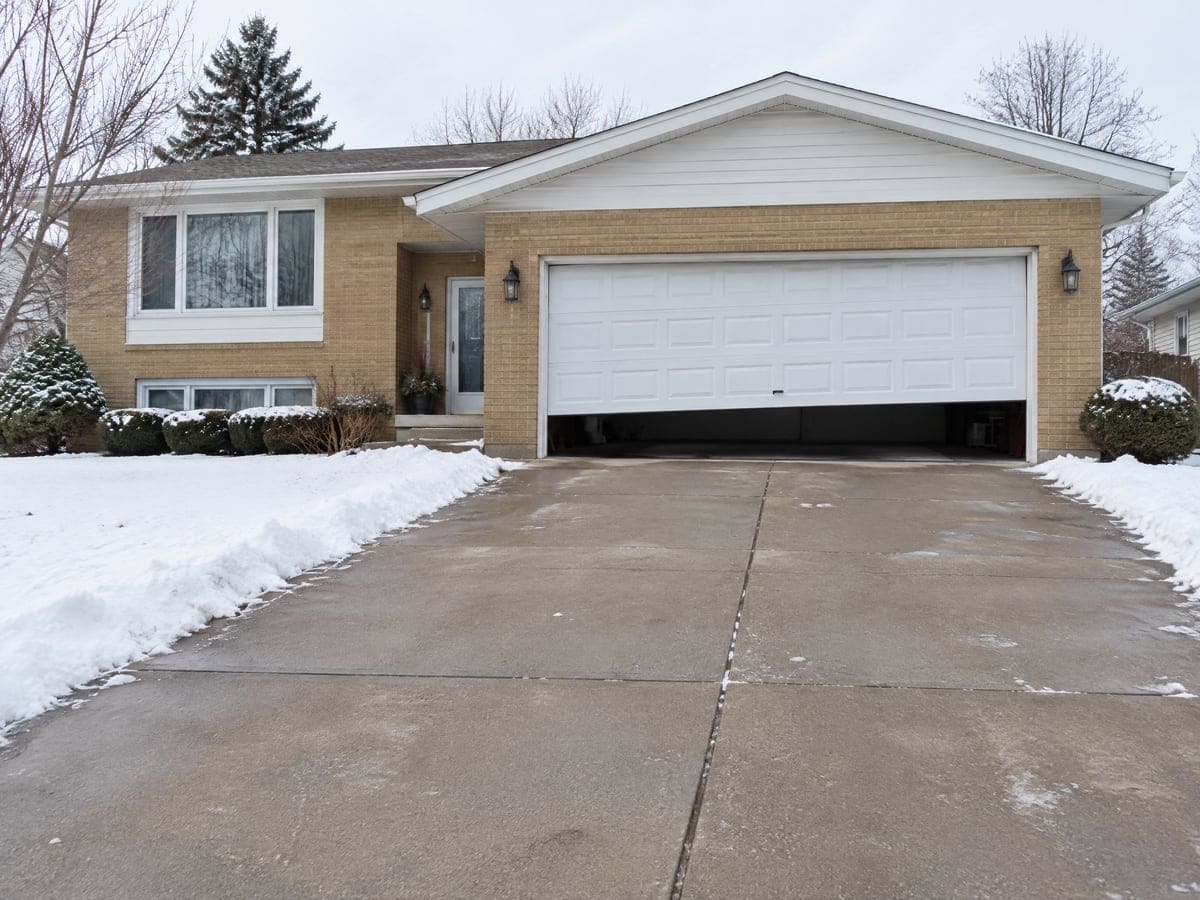
Right now, before anyone touches the door
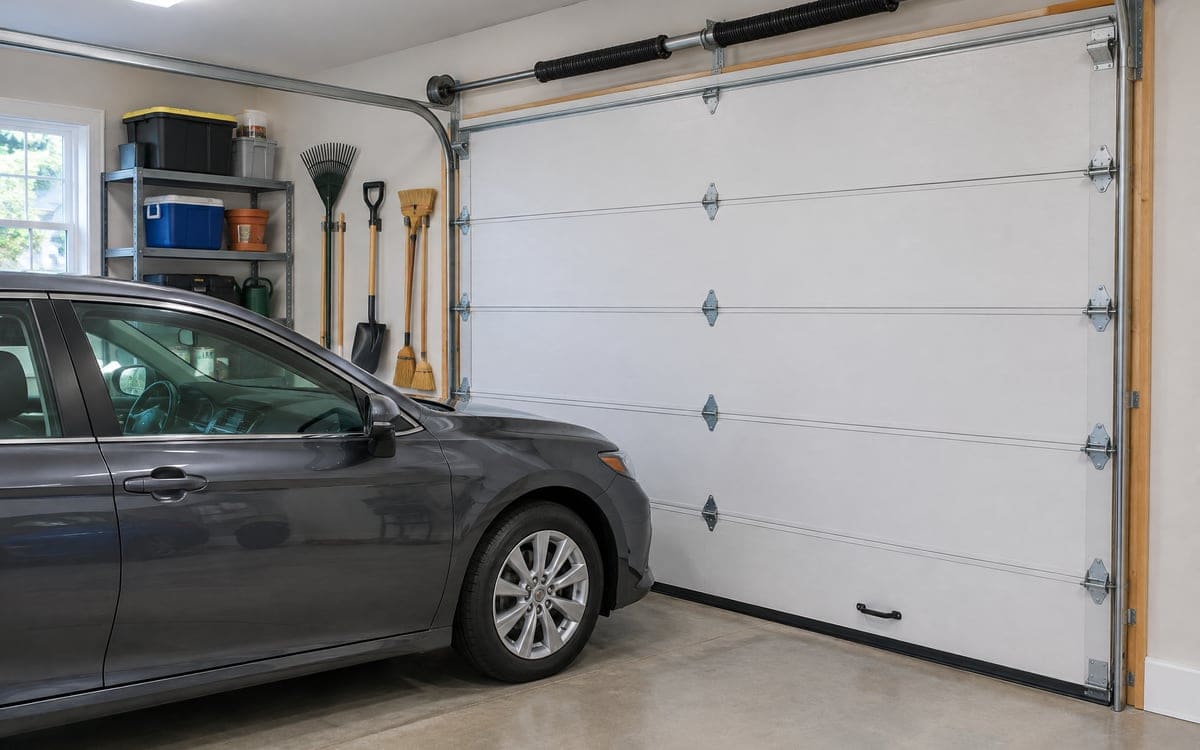
If anyone is hurt or pinned under the door, call 911 before anything else. Everything below is for a door that nobody is caught under.
People, pets and cars stay out from under the door
A door hanging on a broken spring, a slack cable or a bent track still has gravity working on it. Nobody and nothing goes under it until a technician has secured it. If a car is parked partway in or out, leave it where it is and keep everyone clear.
The breaker, not the plug
Reaching the ceiling outlet to unplug an opener means standing under an open or hanging door, which is why the breaker in the panel is the right switch. One trip to the panel ends the risk of a remote press or a crossed sensor firing a motor on a door that cannot carry its own weight.
The emergency release stays alone
Do not pull the red handle on the opener's trolley, in any situation. A broken spring with the door up is the most dangerous case, because a disengaged trolley on an unsupported door drops the full weight onto the lift cables and whatever hardware is still intact, but the rule holds for a power outage, a stuck opener and every other case too. Our technicians work the release at the end of their checks, with the door blocked or supported.
Hands off the door
The springs carry most of the door's weight so a human does not have to. With one broken, that load lands back on the door, on whatever is holding it up, and on whoever is reaching for the bottom edge. Lifting a door by hand with a broken spring is a job that hurts people.
What can be secured from inside
A door stuck open changes the house's security line, so the door between the garage and the kitchen or mudroom becomes the new one. Lock it. Move keys off hooks that face the garage opening. Pull anything worth taking out of sight through the house, not through the garage.
A note from a safe spot, then the call
Standing well back, write down what you heard, what you see at the bottom corners, and whether the opener's light is on, blinking or dead. Then phone us at (847) 534-5389 and tell us what you see. For most of these the next step is to leave the door where it is.
| Symptom | Likely cause | What it usually needs |
|---|---|---|
| Door stuck open, bang earlier | Broken torsion or extension spring | A spring that broke with the door up |
| Door shut tight with the car inside | Broken spring, cable off a drum, or opener fault | A door that will not move |
| Door hanging crooked, one corner low | Snapped lift cable or jumped roller | A lift cable that let go |
| Door off the track and leaning | Rollers out, impact, or cable off a drum | A door off its rollers |
| Door dropped hard, now sits closed | Spring failure during a close cycle | Spring repair |
| Door closes then reverses, will not stay down | Sensors crossed, lens iced, or wiring | Sensors that keep reversing the door |
Urgent versus can-wait
A door that is unsafe to leave standing is a different kind of call from a door that is annoying. The call tells us which one you have.
Urgent
- A door stuck open, with no way to get it closed
- A broken spring with the door up and nothing holding it but the opener's trolley
- A door off the track and leaning on the car or the inside wall
- A cable snapped with the door up
Can wait for the next working slot
- A door that is closed and stays closed, with a car at home
- A noise or a reversal you have been ignoring for a week
- An opener that works, but with a flaky remote
- A bottom seal that is tearing in cold weather
We never ask you to lift or prop the door. Call us at (847) 534-5389 and describe what the door is doing; we come back to you with next steps.
From the phone call to a safe door
- The call. Describe what happened, in order: what you heard, what the door is doing now, where the door stopped, and whether a car is in a tight spot. A broken spring, a cable off a drum and a sensor fault sound different; the sound you heard helps us picture the door.
- Arrival and inspection. A technician gets to the door, shuts the breaker off at the panel, blocks or supports the door as needed, and inspects the fault from the floor out. Nothing under spring tension is loosened at this stage.
- We tell you what is wrong and what each option covers.
- The repair happens with the door blocked, the balance gets checked, the reversal gets set, and the door runs its full cycle until the fault is gone.
Barrington winters and doors that will not close
At Chicago O'Hare the normal first measurable snowfall comes on November 18 and the normal last on April 2,1 so the salt-and-slush season runs more than four months. Northern Illinois averages 140 days a year at or below 32 degrees and 16 days at or below 0 degrees.2 Barrington has more than 3,800 driveways, and Public Works cannot clear the snow its plows leave on them, recommending that homeowners wait until the street is plowed curb to curb3 before clearing the driveway. A door that will not open with a car behind it is a problem the moment that wait begins. Why springs reach the end of their cycle rating in a Barrington winter is a short guide for the days around a hard freeze.