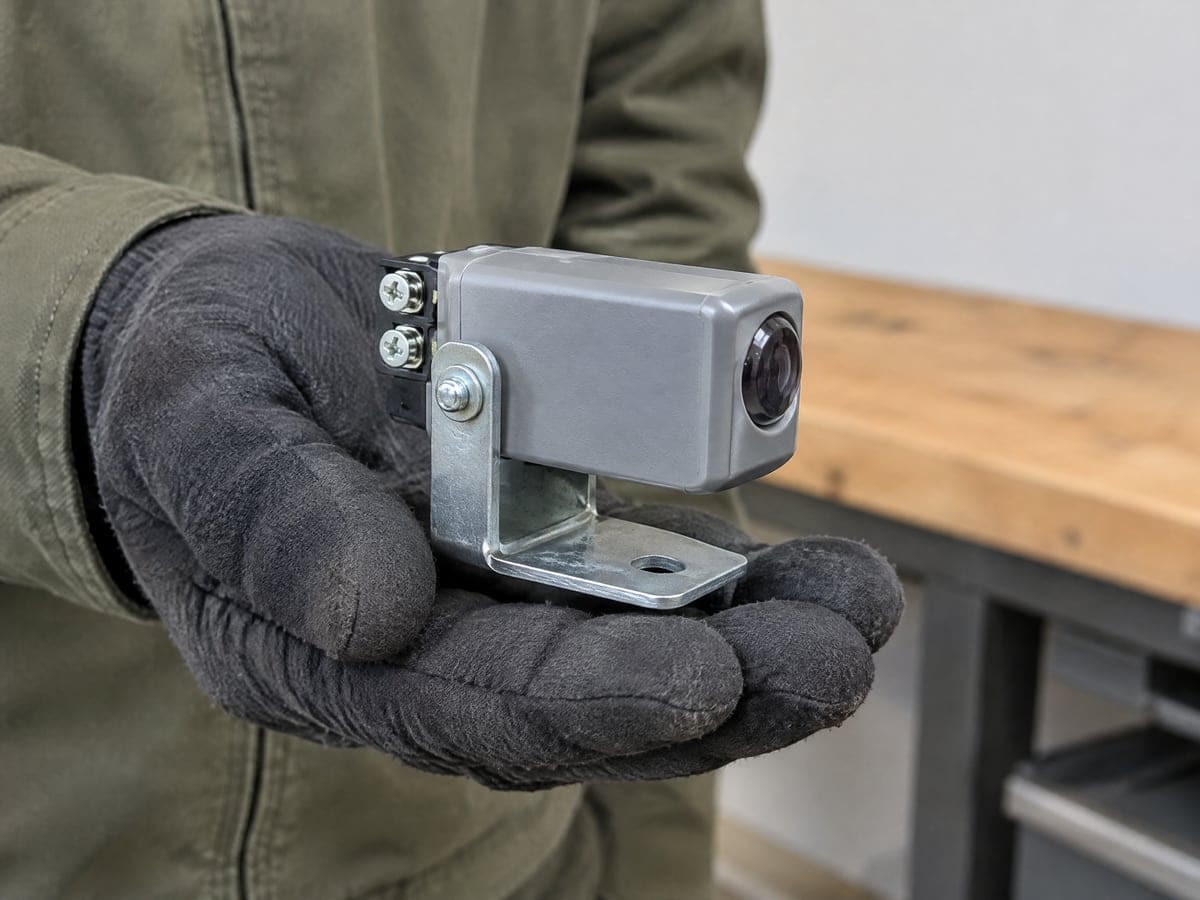
What is the sensor doing?
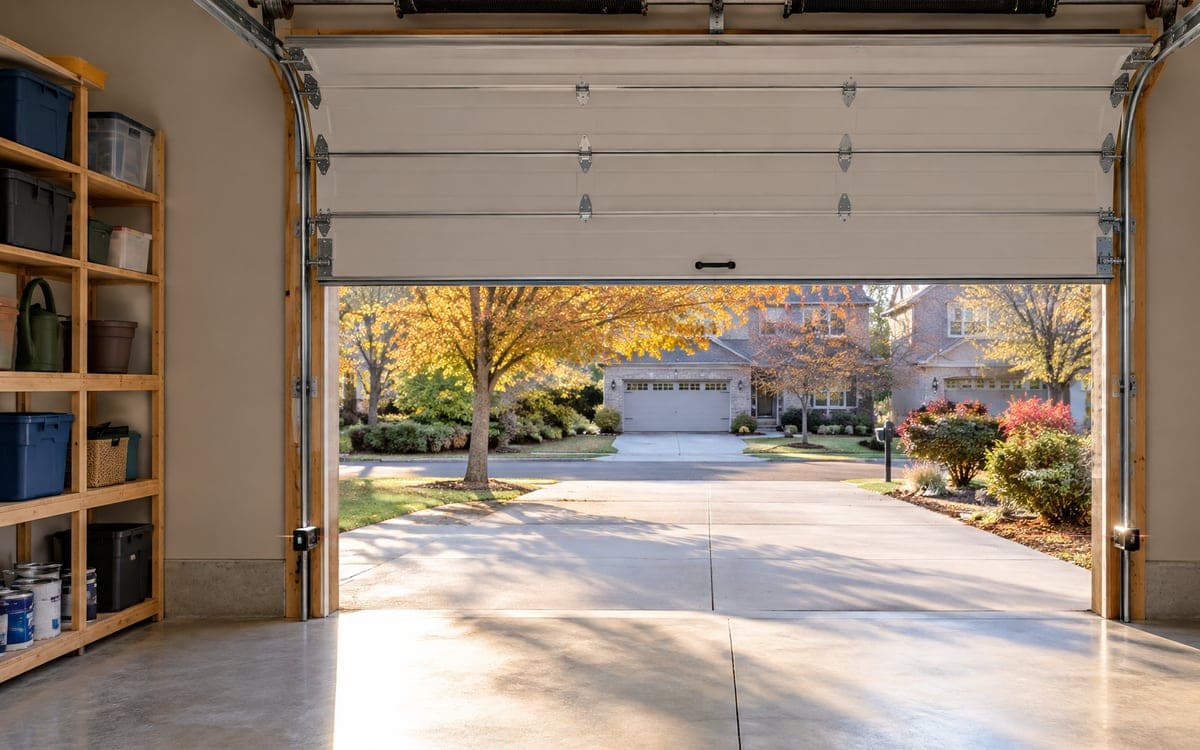
The photo eyes stand on brackets about six inches off the slab, one on each side of the opening. A beam runs between them. When the opener gets ready to close, it reads the beam. A clear beam closes the door. A broken beam, a weak signal, or a sensor that cannot see its partner sends the door back up.
1. The indicator lights on both photo eyes
Each sensor shows a light. On most openers one light is a steady color on the sending side, and the other is a steady color on the receiving side when the beam is clear. A blink on the receiver means the beam is weak or lost. If a light is dark on both, power to the sensor is the first check.
2. Alignment and the brackets they sit on
The receiver has to see the sender along a straight line. A mop that knocked a bracket, a bike that leaned on a sensor, or a shelf unit set too close can each knock alignment off by the fraction of an inch that matters. The technician reads the receiver light while easing each bracket.
3. Dirt, cobwebs, snow and low sun on the lenses
A film of garage dust is enough to drop a signal. So are cobwebs, a smear of lawn fertilizer, a clump of snow on the bracket, and a flashlight-strength beam of autumn sun shining straight into the lens from the open door. A dry cloth clears the first few. The sun is a question of the time of year and the direction the garage faces.
4. Wiring along the wall and at the opener terminals
The low-voltage wire runs from the sensors to the opener terminals, usually stapled along the wall and up the ceiling joist. In an older garage the wire is often stapled through its insulation, spliced to a different gauge, or sharing a staple with a Romex run. The technician checks each visible splice and resets the terminal screws at the motor head.
5. The opener's own reversal setting
Each opener has a close limit and a reversal sensitivity set at install. Over time, either can drift. A down limit set too far, or a close force set too sensitive, makes the door reverse the moment the bottom seal touches the slab. A close limit set too short stops the door above the floor with a line of daylight still showing. The technician reads what the opener sees against where the door actually is.
6. The reversal test with an object on the floor
The last step on every sensor visit is a reversal test. A length of 2x4 or a block of wood on the floor under the beam, the door closed from the wall, and the door should reverse off the block. If it does not, the sensors are not doing their safety job and nobody leaves until they are.
| Symptom | Likely cause | What it usually needs |
|---|---|---|
| One sensor light dark | Lost power or a cut wire | Terminal reseat or a new wire run |
| Blinking receiver light | Weak alignment or dirt on the lens | A clean and a realignment |
| Door reverses at the same height every run | A dirty lens or close limit set wrong | Lens clean, then close-limit adjustment |
| Door reverses on bright afternoons | Direct sun into the lens | Sensor hoods, or a shift of the brackets |
| Door closes only with the button held | Opener does not trust the beam | Wiring and alignment check at the opener |
| No sensors at all | Older opener without a photo-eye circuit | A newer opener with sensors fitted |
When we realign or rewire and when the sensors come out
When alignment and a clean lens fix it
A realignment, a wipe of the lens, a reseat of the opener terminals and a straightened bracket close most sensor calls. The parts are small and the labor is a visit, and the door is back to a safe close on its own. The reversal test is the proof.
When new sensors or a new opener are the answer
Sensors that have been underwater, that read dark on both lights, or that will not hold alignment through a season come out and new ones go in. An opener old enough to have no photo eyes at all is a separate conversation; the right page for that is a newer opener with sensors. Running a door with no sensors is not a safe way to leave the garage.
At the opening we write up what each option would cost before any work starts. The reversal test runs before we leave.
Parts our technicians usually carry for sensor work
The van carries complete sensor pairs with brackets and mounting hardware, a run of two-conductor low-voltage wire for a fresh run between the opener and the sensors, a few short sunshield hoods for west-facing openings, a staple gun, and the hand tools for the opener terminals. The opener behind the sensors sometimes needs its own repair, and gear kits and logic boards for common openers often ride on the van too.
From your call to the reversal test, step by step
- You tell us when the reversal started, whether the door closes at all, and whether a sensor light is dark or blinking.
- The technician arrives, reads the sensor lights with the opener on and the door closed, then switches off the breaker at the panel before touching the brackets or any wiring. The opener's own history gets a look if the owner can show it.
- We walk you through the fault and name the price for the fix. The reversal check on a tune up is the same test that closes a sensor visit.
- The repair goes in, the breaker goes back on, and the reversal test runs with an object on the floor while you watch.
Why Barrington photo eyes see more trouble on bright afternoons
Local housing plays into the fault pattern. In Barrington village, about 67 percent of the housing units were built before 1980. In an older garage, the low-voltage wire feeding the sensors is often an addition from a later opener upgrade, stapled on and spliced along the way, so the technician checks the splices before the lenses. A sensor fault that reads like dirt is often a splice that let go in a cold snap, or a staple that cut through its own insulation.
The seasons work on the lenses too. At the official Chicago climate site, the normal first measurable snowfall of 0.1 inch or more comes on November 18 and the normal last on April 2. During those months a sensor on a bracket next to the vertical track catches blown snow, slush and the brine film that comes off the car. A low afternoon sun through a west-facing opening peaks during late fall and early spring when the sun sits low. Shade hoods, a slight tilt of the bracket, or a different sensor height usually clear it.