What we work on
Residential garage doors across their whole range:
- Springs, lift cables, drums and bottom brackets.
- Rollers, hinges, tracks and the brackets that hold the track to the jamb.
- Sections with dents or cracks, where a replacement panel can still be found.
- Photo-eye sensors, bottom seals and weather stripping.
- Openers and their remotes, keypads and wiring.
- Yearly tune ups and safety checks.
- New doors, replacement doors, and chain, belt or wall-mount openers.
The full services list covers each one on its own page.
What we do not work on: commercial overhead doors, loading dock doors and driveway gates. If a call turns out to be on one of those, we say so and leave it to a crew set up for the work. Taking a job we are not set up for would help nobody.
How a call goes
A job starts with the call. You phone, we pick up, or you leave your details on the callback form below the number.
The questions on the first call are the ones that tell us which parts to bring:
- What the door did last.
- Where it stopped.
- What you heard.
- The rough size of the door, single or double.
- The opener's style, chain, belt or screw drive.
- Whether a car is inside.
- For a new door, whether the house is in Barrington's historic district, since that shapes what the Village will accept.
Some questions can be answered on the phone. A price for a repair cannot. The part, the door's weight, the shape of the hardware around the broken piece and the opener's state all move the number. The technician gives it at the door, after the look, before any work is turned.
The callback form on every page is the second way in. Leave your name, your number and a line about the door, and we will call back. For a door stuck open after dark or a trapped car, phone instead.
At the door
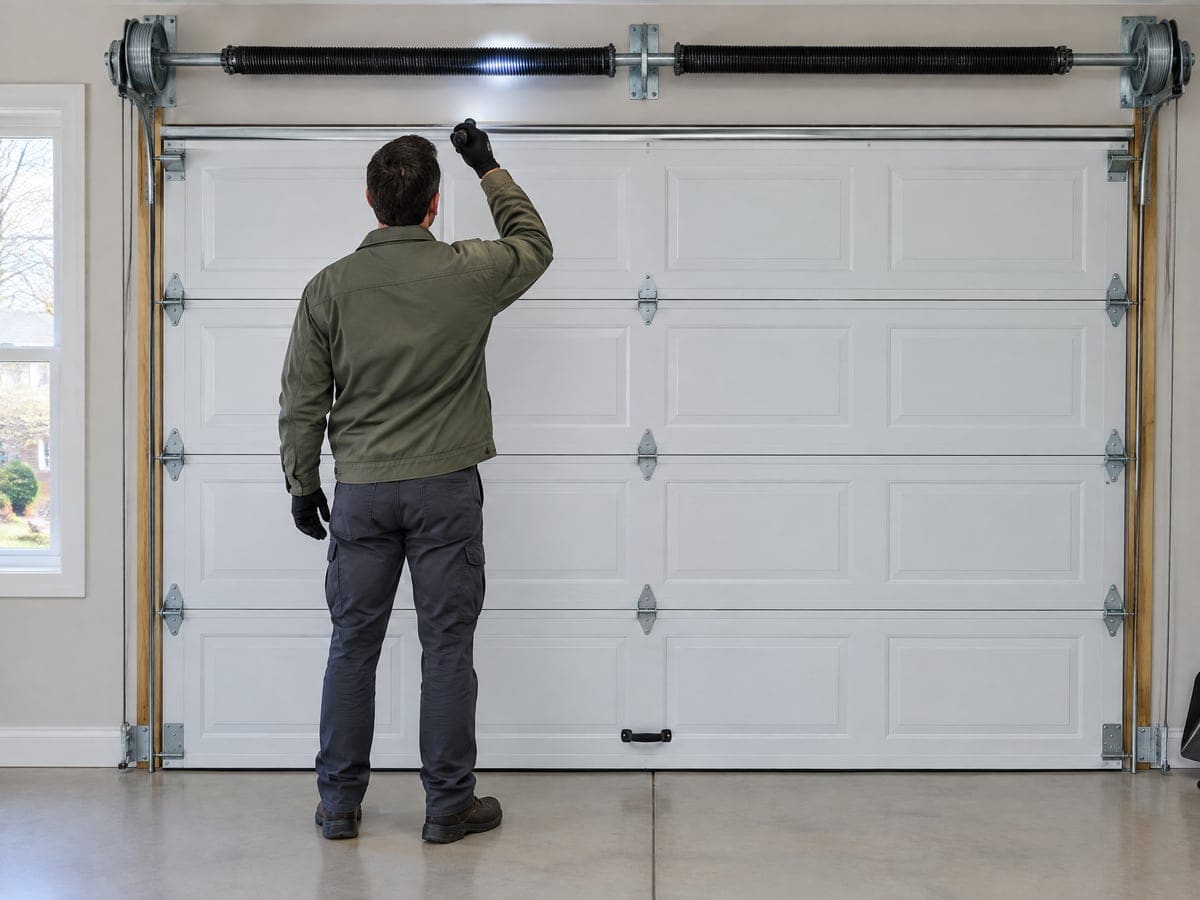
A visit begins with the door closed and the opener's power turned off at the breaker. From there, a technician works through the hardware in order: the springs on their shaft, the cables along their drums, the rollers in their hinges, the track down to the lag screws in the jamb, every section of the door and its bottom seal, and the opener with its drive, logic board and photo eyes. For the balance check, the technician disconnects the opener from the door and lifts the door partway to see how the springs are carrying the weight; for the reversal check, the opener is reconnected and the door is run through a close. Both checks belong to the technician, not the homeowner.
The quote comes before the first fastener is turned, and each line is explained. If a repair is the cheaper call than a new door, we say so. If a new door is the cheaper call over a few years, we say that too, and we walk through why.
Hardware stays with the technician. The emergency release is a technician's tool, not a homeowner's. Springs, cables and bottom brackets carry the most tension with the door closed, and nothing on that list is something to work near.
Older and historic houses in Barrington
The village has a lot of houses from before 1980, so a job often starts with a look at the garage's bones rather than the door alone. On wood and overlay doors, materials and panel patterns matter as much as the mechanics. On older openers without photo-eye sensors, safety comes before age in the discussion of what to replace. Old wood jambs that have already taken a dozen fastenings may need fresh backing before new lag screws can bite. The historic district guidelines cover the Village side, and how we find the fault covers the rest. The safety checks we run are the usual next step after a repair on a door that has not been looked at in years.
For a house in the Village's historic district, we read the design guidelines before quoting a new door, and we point owners to Village staff whenever a Certificate of Appropriateness may be in play. Village staff can tell you whether a given address is in the district.
Garage door work around Barrington
Garage doors around Barrington are what this service covers, on housing from the pre-war frame homes through the ranch years and newer builds. Garage doors around Barrington looks at the picture by housing era.
On the garage door itself, the work is the same across housing of every age; it is the paperwork question for a given job that goes to the Village. Permit questions for garage doors go to the Village's Development Services Department, and association questions for attached homes go to the board that holds the covenants.
Checking us, or any garage door company
Every contractor and subcontractor on a permit must be registered with the Village before the permit is issued. Whether a given garage door job needs a permit is for Development Services to answer, and contractor registration applies on any job that does. On the historic side, the Village maintains its own Historic Overlay District on top of the National Register listing, and the garage door design guidelines come from the Village's own ordinance. How to check any garage door company covers the fuller list of questions worth asking.
Beyond registration, ask any company you call for the price before the work starts, for the exact part the quote covers, and for an explanation of any line that is not obvious. Ask whether the price covers safety cables where the door has none now, whether the opener's reversal check will be run after the repair, and whether the technician will show you the broken part before it leaves. A company that cannot answer those questions is one to keep looking past. How a job gets priced spells out what should be on the quote.
If you want to ask any of that of us, phone. Common questions are answered on their own page, and get in touch is a short page too.