A torsion spring breaks with a gap in the coil
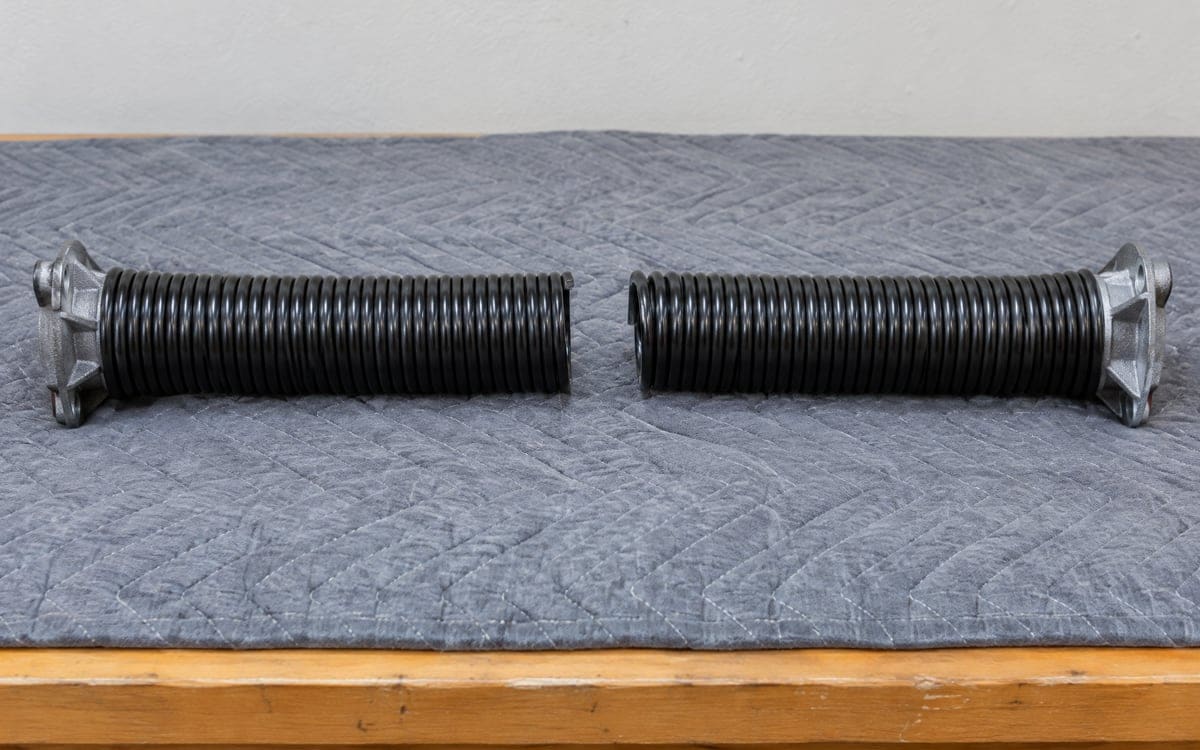
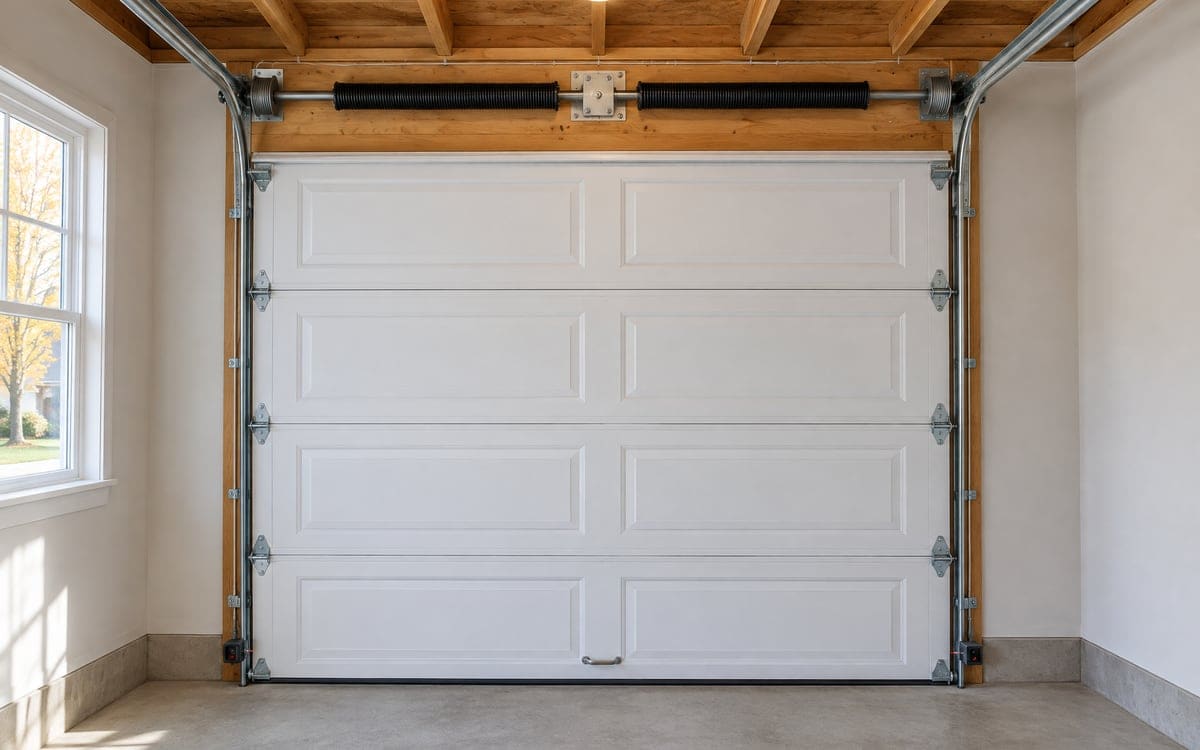
The torsion spring sits on a horizontal steel shaft directly above the door. When it is working, the coils are packed tight against each other along the full length of the spring. When it breaks, one of those coils opens up, and the spring is now in two separate halves. The gap can be a half inch or a few inches wide, and it is almost always obvious from the floor if the garage light is on.
A torsion spring carries the most tension with the door closed, so a spring can break with the door at rest or as it starts to lift. The sound is a loud bang that can be heard inside the house. On the morning after, the sign is the gap in the spring and a door that will not open on the opener. Both halves of the spring stay on the shaft because the shaft and bearings hold them there; what moved was the stored energy, not the pieces.
Older garages sometimes run on a single torsion spring where a wider door would use two. The median year built for housing in Barrington is 1971.1 A one-spring door with a broken spring looks the same as a two-spring door with one broken side, except the lift is now zero instead of half.
An extension spring hangs loose or is missing
Extension-spring doors use two long coil springs that run along the ceiling, above the horizontal tracks on each side of the opening. A working extension spring is stretched out when the door is closed and shortens as the door is lifted. When one breaks, the sign is a spring hanging loose from one of its hangers, or a spring that is only connected at one end, or on an uncabled door a section of spring you may not see at all.
Older doors are where extension springs most often turn up, and in Barrington an estimated 575 housing units, about 13 percent, were built in 1939 or earlier.2 A broken extension spring with no safety cable through the middle is a reason to keep well away from the door; the pieces may be where they landed, which can be across the garage. Our guide to safety cables covers what a cable is for and why older doors often lack them.
Look at each spring from a safe distance, with the door closed and the opener powered off at the breaker if the door is hanging at an awkward height. A broken extension spring is usually easy to spot: one spring is stretched normally and the other is not, or one end of a spring is dangling.
The door feels dead to the opener
If both of the above are hard to see, the opener will give you a third sign. On a torsion-spring door with a snapped spring, the opener still runs when you press the button, but the door barely rises an inch or two before it stalls or the opener strains and clicks off. Some newer openers show a force-fault flash when this happens. Older openers just stop with the motor straining.
On an extension-spring door, one broken spring lets the door lift crooked, if it lifts at all, lopsided to the broken side. The door is now heavier than the opener was ever meant to lift on that side, because the spring was taking almost all of the weight before and is taking none of it now.
A dead-to-opener door with no spring assist is not a door to keep trying. If the opener runs, the chain or belt will not lift the door, and continued use is how a bent top section or a spring torn out of its hangers happens next. Our emergency repair page covers broken-spring calls when the car is boxed in.
What not to do with either type
A broken spring door is one of the clearest cases where the right next step is to leave the door alone. The following are not DIY, regardless of the reason:
- Do not lift the door by hand. Without the spring, the full weight of the door is on anyone trying to lift it, and the door can slam closed if hands slip.
- Do not pull the emergency release. On a hanging door, pulling the release lets the door drop. The hardware is not designed to hold the door at height alone.
- Do not wind, unwind, loosen or replace any spring, cable, cable drum, bottom bracket or shaft hardware. Everything on that list is under spring tension or is holding it, and injuries from these parts can be severe.
The homeowner steps are visual. Note which spring is broken from a safe distance, what the opener does when the button is pressed, and what you heard and when. Call us with those details.
Reading the three signs together
| What you see or hear | Likely spring state | What it usually needs |
|---|---|---|
| Loud bang, gap in a torsion coil, door will not open | Broken torsion spring | Both springs replaced, cables and drums inspected |
| One extension spring longer than the other, or one hanging loose | Broken extension spring | Both springs replaced, safety cables added if missing |
| Opener runs, door rises an inch or two and stops | Broken spring on either type | Full inspection, then spring replacement |
| Opener runs, door lifts crooked and stalls | Broken extension spring on one side | Both extension springs replaced together |
| Spring looks fine, door still will not open | Not the spring: an opener, cable or track issue | A full look at the system; may be a different fix |
| Door closed and quiet, no bang heard, opener light flashes | Often an opener or sensor fault, but a spring break can go unheard | Check the springs visually from a safe distance before ruling the spring out |
For symptom problems that end up not being a spring at all, our won't open or close page walks through the other causes.
When a tired spring reaches the end of its cycles
A spring is rated for a set number of open and close cycles, which varies by wire size. A door that runs several times a day uses those cycles faster than one that opens once. Our page on garage door springs and the cold season walks through the climate dates at Chicago O'Hare and what a spring call looks like in the long cold stretch here.
When the spring has broken and the car is inside the garage
A broken spring with the car inside leaves the car stuck. The door is heavy without the spring, the opener will not lift it, and the car cannot come out. Trying to force the opener drops the door further and bends what is holding it. Our spring repair page covers how the visit goes, from measuring the broken spring to sizing the replacement.
What a broken spring usually looks like
The common picture is a torsion spring with a clean break near the stationary cone, a two-inch gap in the coil, and both halves still on the shaft. On an extension system it is a spring that has pulled free of its front hanger, with the lift cable hanging slack. On an overnight break, the sound was in the house but did not register as the garage.
The fix is the same shape in each case. Both springs on a two-spring setup are replaced together, since the one that did not break has been through the same cycles as the one that did.