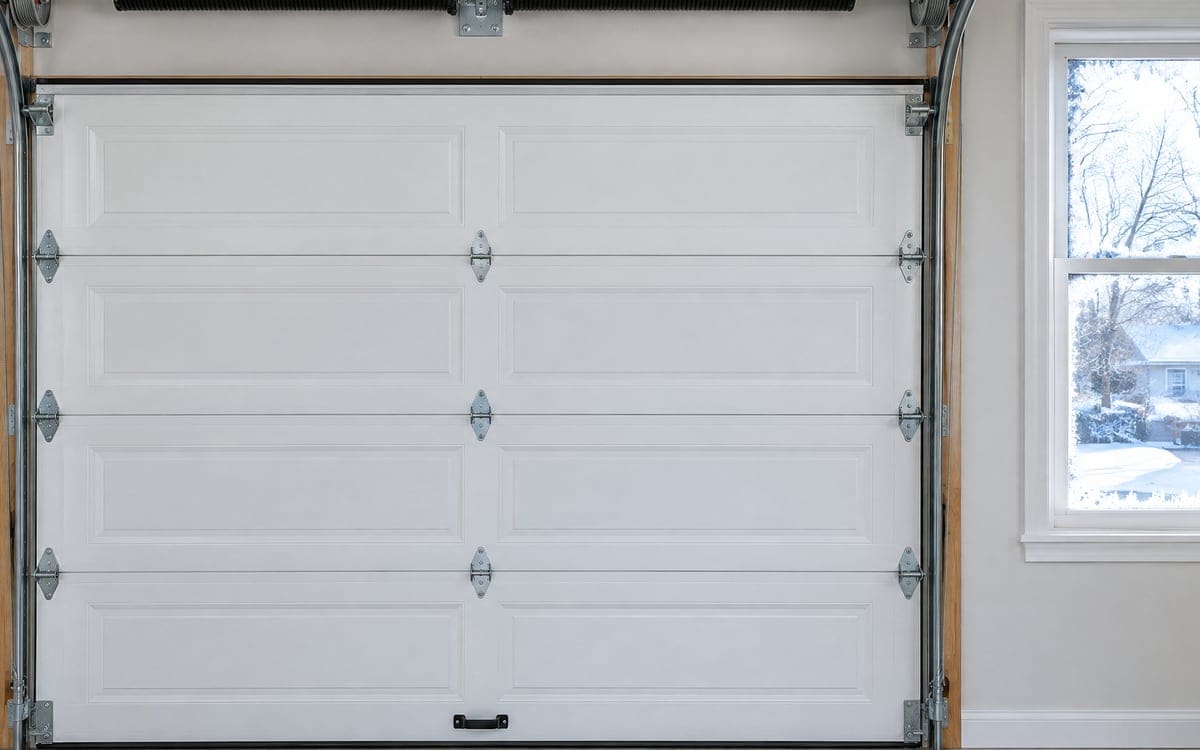
Northern Illinois spends about 140 days a year at or below freezing
Cold is a long season here. Northern Illinois averages 140 days a year at or below 32 degrees and 16 days at or below 0 degrees. A door that comes up every morning and shuts every evening spends most of those 140 days under some version of the same load, with cold as the backdrop.
Sixteen of them come in at or below zero
Days at or below zero fall into a tighter window than days below freezing. On a January morning that reads minus five, the garage interior is cold through and the door sections pull closer to their stiffness limit. A door that was running smoothly in October will suddenly sound different in that cold air. The change is in the lubricant on the hardware. Stiff grease on rollers and bearings adds friction the opener has to overcome, so the whole system runs under more resistance than it did in October.
The cold stretch normally runs from mid October to late April
The season's edges are set by the first and last freezes at Chicago O'Hare, the official Chicago climate site. The normal first autumn temperature of 32 degrees or lower at O'Hare comes on October 19 (1991 to 2020 normals), and the normal last spring temperature of 32 degrees or lower comes on April 21, with the latest on record for the official Chicago site falling on May 25, 1992. Those two dates frame about six months of cold risk at O'Hare. Measurable snow runs on a similar calendar: the normal first snowfall of 0.1 inch or more at O'Hare comes on November 18 and the normal last on April 2. That is enough cold mornings for any weakness in a Barrington garage door spring to find its moment.
A healthy spring does not snap because it is cold
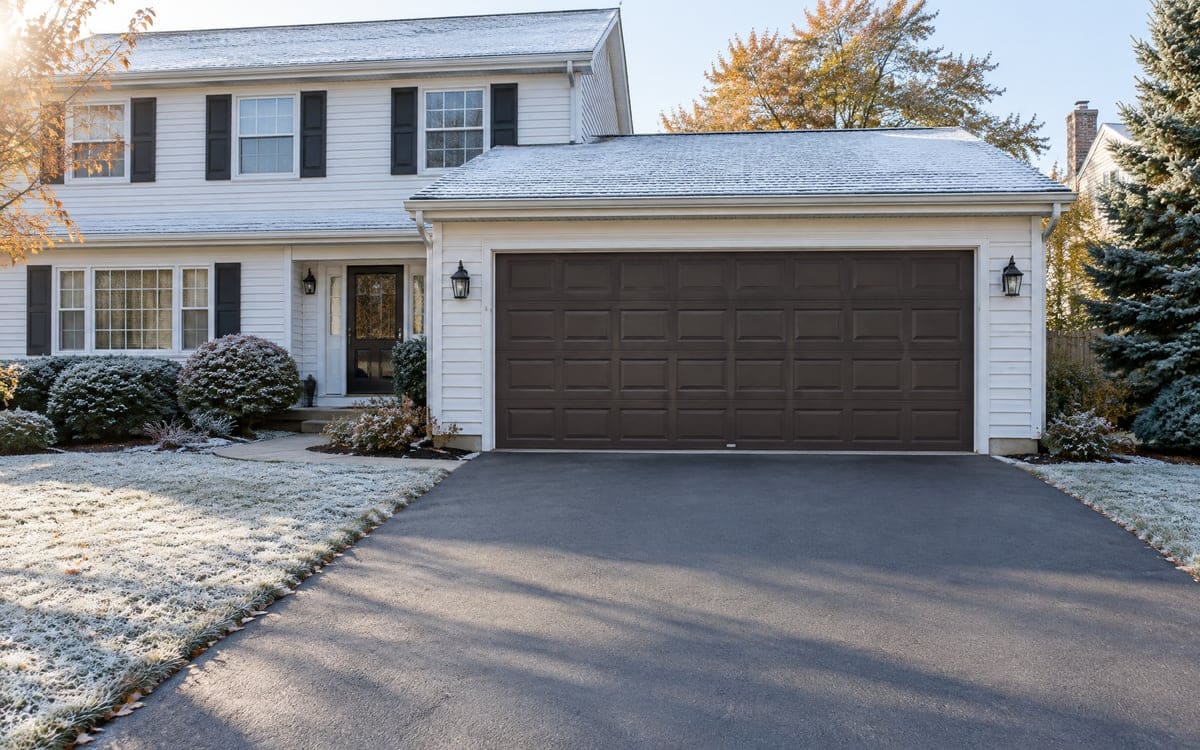
A torsion spring stores energy as it winds up, and gives that energy back as it unwinds. A spring sized for the door and in good condition has been designed for the cold the door lives in. On its own, winter does not break a spring still inside its cycle rating. A spring that goes in October was already near the end of its cycles, with the cold morning as the trigger rather than the cause.
A tired spring fails when the load is highest
The highest load on a torsion spring comes at the moment the door first starts to open, with the full weight of the sections hanging. For a spring near the end of its cycle rating, that first-inch load is often what finishes it. The result is a snap the household hears, a gap in the coil above the closed door, and an opener that strains for an inch and quits. For spring replacement, both springs on a pair are replaced together, since the second spring has done the same cycles as the first and is likely close behind.
The opener can mask a weak spring for a while
An opener's job is to lift a door that is already mostly balanced by its springs. When a spring is tired, the door is heavier at the floor than the opener expects. The opener strains to make up the difference, which hides the underlying problem for a while. For a few months, nothing seems wrong at the ceiling. Then the weakest cycle comes along and the spring parts, and the opener is left with the full weight of the door and no spring tension to help it. A cable job often goes with a broken spring because the sudden slack lets a cable jump its drum.
Older garages often still run extension springs
Extension springs are the kind that run alongside the horizontal tracks rather than on a shaft above the door. On older garages where the headroom above the door never fit a torsion shaft, extension springs are often still what carries the door. The median year built for housing in Barrington is 1971, and about 67 percent of Barrington's housing units were built before 1980, so a share of the housing is old enough that older spring setups are still around. In cold weather extension springs behave much the same as torsion springs: a healthy one is fine, a tired one lets go. The piece to look at on these setups is the safety cable, a thin cable that runs through the center of the extension spring to catch a snapped end. On a visit, our technician checks both the spring and the safety cable.
Signs a spring is near the end, from a safe spot
A spring near the end of its run usually tells on itself before it goes. The door hesitates on the first few inches off the floor. The opener strains through the lift, running longer than it did a season ago. The spring itself may make an audible pop or creak on each cycle, which is often the first thing a noisy door service comes out for. From inside the garage with the door closed and the opener off at the breaker, the spring is visible on the shaft above the door; a visible gap in the coil is the most unmistakable sign and means the spring has already parted. All of this is a watch-only check, from a safe distance. Nothing on a spring should be touched by hand, and nothing should be adjusted with a ladder near a loaded coil.
Matched pairs and higher-cycle springs
Springs come rated for a number of cycles, where one cycle is one open and one close. A door that runs several times a day uses up cycles faster than one that opens once. On replacement, higher-cycle springs cost more up front and last longer in service, which on a Barrington garage with a six-month freeze season often works out. A good fall tune-up catches a spring heading toward its last cycles while the garage is still warm and the schedule is open, which gives you more choice on the replacement than an emergency call in January does. On a pair, both springs are replaced together; a mixed pair rarely stays matched for long.
If a spring breaks on a frozen morning
The first thing is to leave the door where it is. A door with a broken spring is far heavier at the floor than you expect, and lifting it or propping it is not safe. An emergency call for a spring that broke with the car trapped is the right move if someone needs to be out of the garage. If the car can stay put, a regular call during the day is fine. Keep people, pets and vehicles out from under the door. Switch the opener off at the breaker at the panel rather than reaching the ceiling outlet with the door up. Leave the emergency release alone; a broken-spring door that is up will drop hard the instant that cord gets pulled.
The cold-season figures for a Barrington garage
| Figure | What it is | What it means for the door |
|---|---|---|
| October 19 | Normal first fall freeze at Chicago O'Hare, 1991 to 2020 normals | Overnight lows at the garage start pulling into freezing-adjacent territory |
| April 21 | Normal last spring freeze | The season does not fully release until late in the month |
| May 25, 1992 | Latest spring freeze on record for the official Chicago site | Late cold snaps are rare but on record |
| November 18 | Normal first measurable snow (0.1 inch or more) at O'Hare | De-icer, slush and the first ridge across the driveway |
| April 2 | Normal last measurable snow at O'Hare | Usually the end of measurable snow at the official site |
| About 140 days | Northern Illinois days at or below 32 degrees | The low end of the spring's working temperature range on about four months of twelve |
| About 16 days | Northern Illinois days at or below 0 degrees | The hardest cycles the hardware runs through all year |
For the hardware side of the same cold stretch, the seasonal garage door safety check guide covers what to look for in fall and spring, and the road salt and rust guide covers the other thing winter does to a garage door.