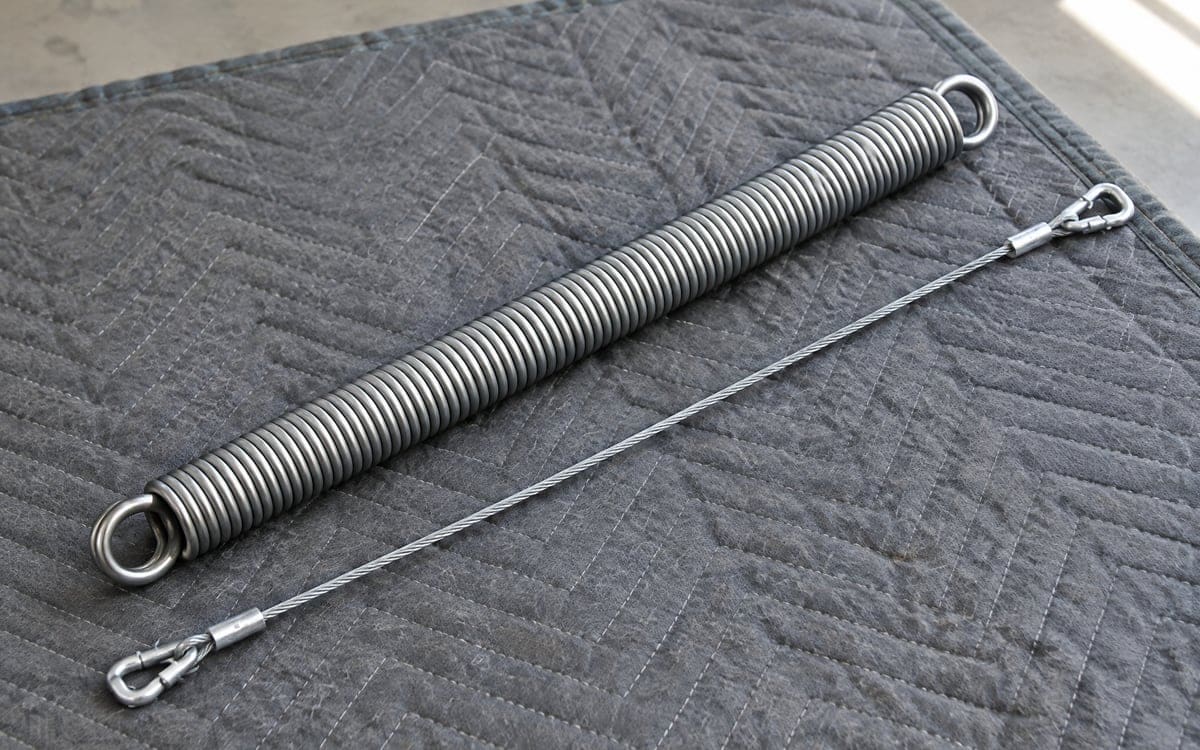
Extension springs stretch along the ceiling tracks
An extension spring door uses two long coil springs that stretch out when the door is closed and pull back as the door is lifted. The springs sit above the horizontal track on each side, running from a back hanger toward the front of the opening. Thin cables, called lift cables, run from the bottom of the door up through pulleys at the front and back and attach to the spring, so the spring is pulling the door up through the cable. It is a simple layout and a common one on older houses.
The weak point is the spring itself. When a coil snaps, the broken end does not stop. It carries all the stored energy at once, and without something to hold it, the two halves of the spring can travel the width of the garage. That is the hazard a safety cable is there to stop.
A safety cable runs through each spring
The safety cable is a separate steel line that threads straight through the middle of the coil for the full length of the spring. One end anchors to the back hanger behind the spring; the other end anchors to the bracket at the front, near where the horizontal track meets the top of the opening. Both ends are fixed to the structure, not to the spring. The cable takes no load while the spring is working normally. Its only job is to be there the second a spring snaps.
When the spring breaks, each half of the coil is suddenly free. Because the cable is threaded through the center, each piece slides down the cable instead of flying off into the garage. The pieces still move, but they stay on the cable and come to a stop at one end or the other. From across the garage you hear a loud bang and see slack hardware; without the cable, you can also see parts of the spring embedded in a wall, a car panel or worse.
The safety cable runs through the spring and is separate from the lift cables that attach to the door. The lift cables are a different system, and they do not get a safety cable because they do not store energy. If a lift cable is frayed or slack, our cable repair page covers that fix.
Older doors were often installed without them
A big share of Barrington's housing dates from the mid-century stretch: 1,072 of 4,424 housing units, about 24 percent, were built in the 1960s and another 887, about 20 percent, in the 1970s.1 The age of the garage is one input the technician looks at on an inspection.
From the ground, you can usually see whether the cable is there without touching anything. Look at either spring with the door closed and the garage lit well. A plain spring with nothing running through the middle of the coil means no safety cable. A spring with a thin line visible along the inside, running from end to end, means the cable is there. Keep well clear of the spring while you look.
Barrington's pre-war housing
Older still than the 1960s and 1970s run, an estimated 575 of Barrington's housing units, about 13 percent, were built in 1939 or earlier.1 A house of that age often reaches a safety-cable inspection on a door that is not the one that went in with the house.
Converting to torsion springs instead
Adding safety cables to an old extension-spring setup is the right fix on many doors. On some doors, the better fix is a different spring system altogether. A torsion-spring conversion moves the springs to a shaft above the door, with cable drums that wind lift cables onto the shaft. The reason to go that route is containment: a broken torsion spring stays on the shaft, so the system does not need separate safety cables to catch loose pieces.
Torsion is not always possible. The header above the door has to be deep enough for the shaft, and the garage ceiling has to allow for the extra height. On an older detached garage with low framing, we sometimes have to add safety cables rather than convert, because conversion will not clear the structure. We cover the longer story of torsion sizing on the spring repair page.
Why the cable matters on an older door
The cable's job is containment. Our notes on springs in cold weather walk through the climate dates and what we check on a winter spring call.
The time to look at the safety cable on an older extension-spring door is before a spring parts, not after. If a spring snaps on an uncabled door, the two halves of the coil carry all the stored energy out into the garage, and a car and a person can both be in that path during a morning opening. With the cable threaded through the spring, each half of the coil slides along the cable and stops at an anchor instead of flying free.
Spring types and what each uses for containment
| Spring type | How it stores force | What contains a break |
|---|---|---|
| Extension spring over each horizontal track | Stretches lengthwise as the door closes | Safety cable threaded through the spring, anchored at both ends |
| Standard torsion spring on a header shaft | Winds around the shaft above the door | The shaft itself; a broken coil stays on the shaft |
| High-cycle torsion spring on a header shaft | Same as standard, built for more open and close cycles | The shaft itself |
| Older extension spring with no cable | Stretches lengthwise, no containment | Nothing: the broken end can travel across the garage |
Garage door spring safety cable is not a bolt-on by the homeowner
The cable itself is a small part, and from a parts standpoint the install looks like threading a line. The problem is where it has to go. The anchor points are at the front bracket and the back hanger, which are under spring tension while the door is closed. Loosening or adjusting any part of an extension-spring system under load is dangerous work for anyone except a technician who has done it before, and nothing about the install belongs on a stool with the door at any position. If an older extension-spring door in the garage has no cable visible through the spring, call us and we will come look.
Safety cables for garage door inspection
When we come out for a spring call or a tune-up, the cable is part of what the technician looks at. On a door that has them, we check that both ends are anchored to the structure, that the line is not frayed or kinked, that nothing is binding against the pulleys, and that the cable is actually inside the spring and not pulled off to one side. On a door that lacks them, we add them if the spring geometry allows it, or we tell you if the better move is a torsion conversion. A tune-up and safety inspection is the usual visit that catches this on a door that has not had service in a long time.
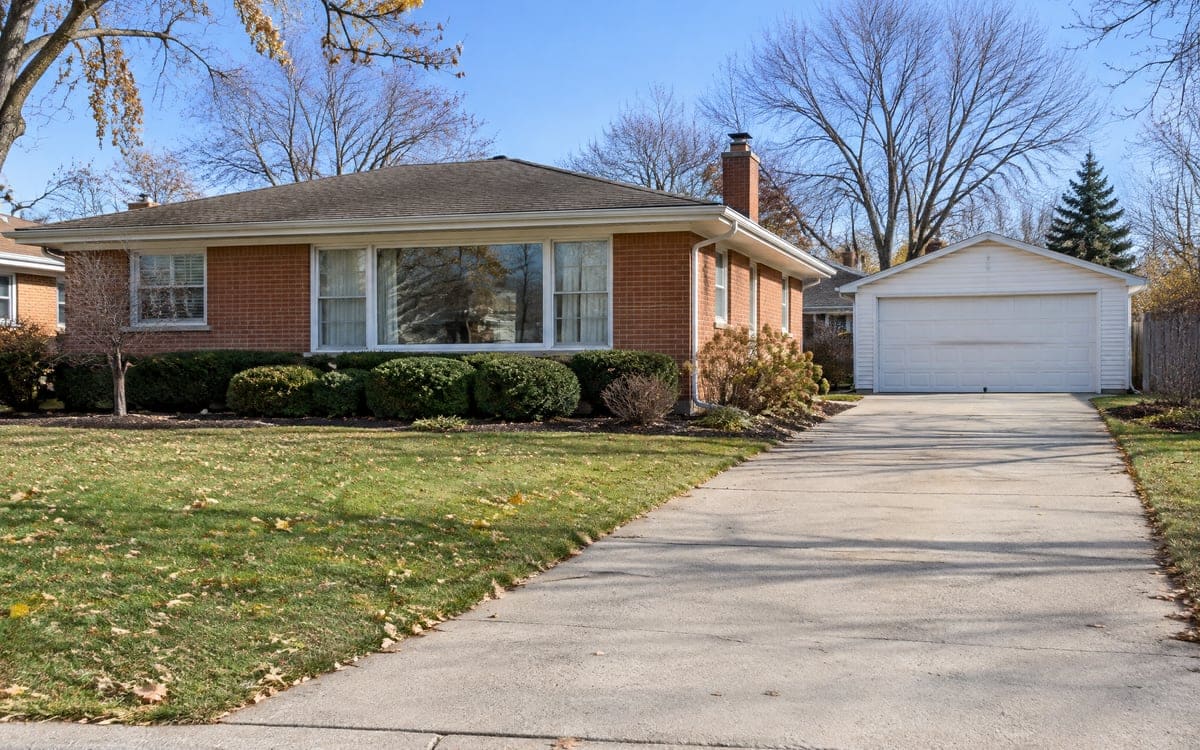
Older garage, older spring choices
Older detached garages come up on the kind of inspection a safety-cable call starts from. The structure above the opening is what decides whether a torsion conversion is on the table; where the headroom does not clear a shaft, safety cables are the containment the setup can get. Our page on older Barrington homes and the doors they came with walks through the doors and spring systems typical of each era, and spring type is a big part of it.