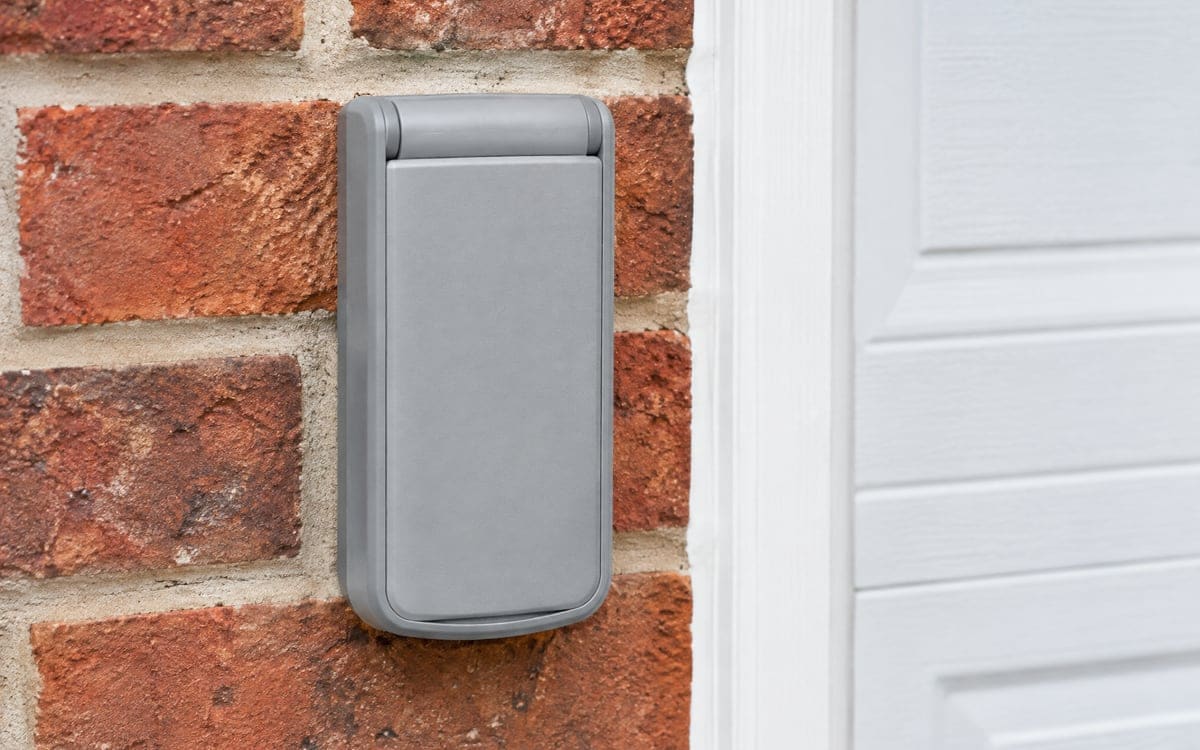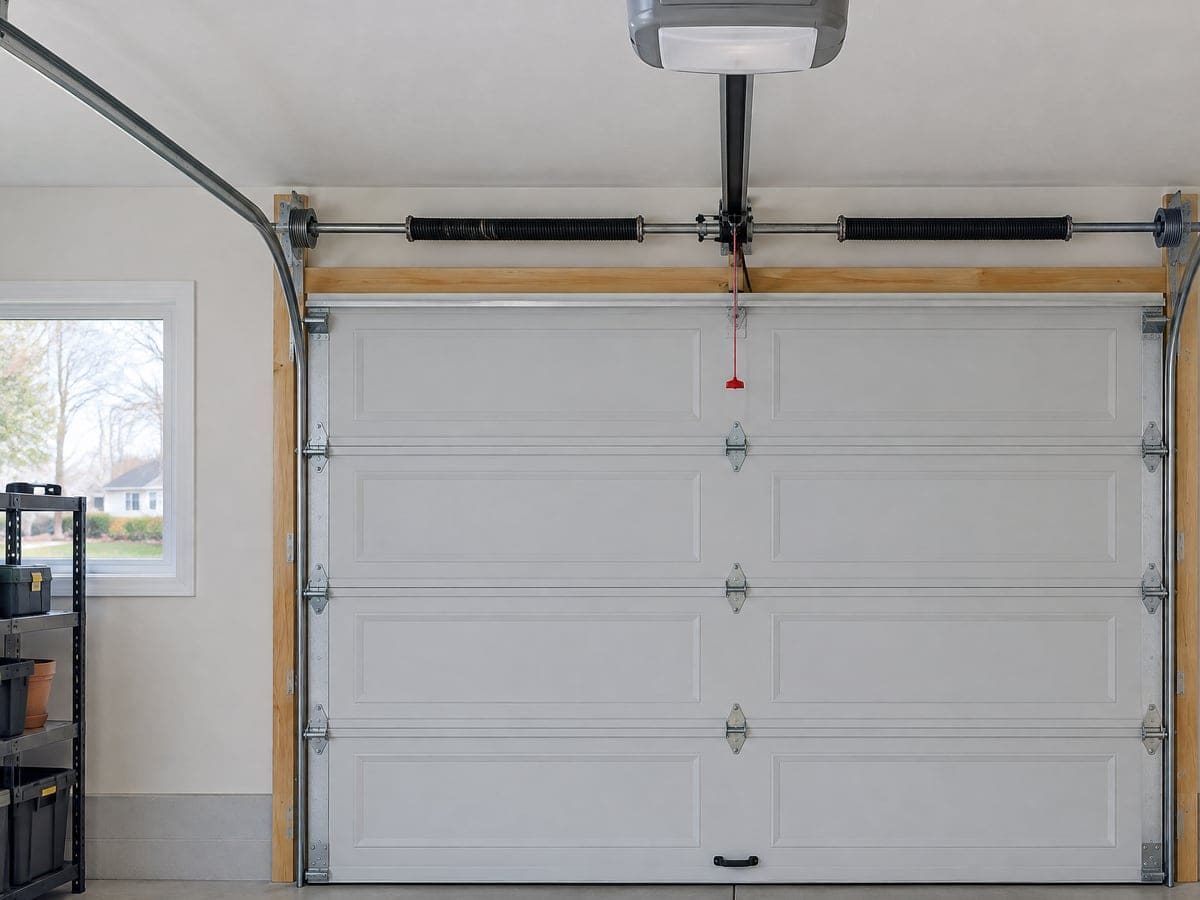
What is the opener doing?
The light pattern, the sound of the motor, whether the door tries to move, and what the wall button does are each a clue to a different failure. On the visit, we work the following checks in roughly this order.
1. Power at the outlet and the breaker
We plug a tester into the ceiling outlet and look at the breaker label in the panel. A tripped breaker is not always obvious: it can sit in the middle position between on and off, so a quick glance down a panel misses it. Keep hands away from the opener while the door is open or hanging; the right move is to flip the breaker for the garage circuit, not to pull the plug.
2. The lock switch on the wall control
Wall buttons carry a lock mode that disables the remotes but still lets the hard-wired button work. A homeowner reaches up to turn on the garage light and the lock bar gets held a second too long. The remote stops working, nothing else does. The fix is a short press, which we can show you.
3. Photo-eye sensors
The two photo eyes six inches above the floor are a common reason a door will not close. A sensor out of line, dusty, sun-blinded, or hit by a leaf blower will stop a close cycle and leave the door reversing. A dedicated page covers photo-eye sensor repair; on an opener visit we align them, clean the lenses, and check the wire.
4. Remote against the wall button
If the wall button closes the door and the remote does not, the problem lives in the remote or its programming. If neither works and the opener has power, the logic board or the receiver is at fault. We carry test remotes to tell those apart.
5. Motor runs, door does not move
A motor that runs with the chain or belt turning, or a screw drive that spins, while the trolley and door stay still points at the drive inside the opener head: a stripped drive gear on a chain drive, a snapped belt, or on a screw drive, a stripped nut. The fix is a parts swap with the door disconnected first by our technician.
6. Door starts, then reverses
A reverse on close is almost always sensor misalignment, a travel limit set too long, or a door binding against track or seal. A reverse on open points instead at the up force setting, usually after a cold night, or at a damaged roller or hinge.
7. Closes only while the button is held
Holding the button to force a close is a sign the sensors are not seeing each other, the wire is broken, or the sensors have been replaced with the wrong parts. We trace the wire and align the eyes so the button closes the door with a single press again.
8. Hums or clicks with no movement
A loud hum, a steady click, or a short growl without movement is often not the opener at all. It is a broken spring, leaving the opener trying to lift a dead-weight door. If it has parted, the fix is a broken spring that makes the opener strain first, then the opener gets rechecked.
| Symptom | Likely cause | What it usually needs |
|---|---|---|
| Motor runs, door still | Stripped drive gear, broken belt | New gear kit or belt, rail re-greased |
| Remote dead, wall button fine | Dead battery, out-of-sync remote, bad receiver | New remote, reprogramming, or a logic board |
| Must hold button to close | Sensors out of line or wired wrong | Alignment, wire repair |
| Door reverses on close | Sensor obstruction, travel limit, binding door | Clean and align, limit reset, door balance check |
| Opener hums, door does not budge | Broken torsion spring, locked trolley | Spring work first, then opener recheck |
| Nothing at all, no lights | No power at the outlet, tripped breaker | Breaker reset, outlet repair |
| Loud grinding on open | Dry rail, worn gear | Rail service, gear kit |
When we repair, and when we suggest a new opener
We repair openers that are reasonably recent, have working photo-eye sensors, use rolling-code remotes, and are built from parts still being made. A drive gear kit, a logic board, a belt, a trolley or a sensor pair are all common repairs; so is a reset of travel and force limits after the door has been serviced.
We suggest a new opener when the unit is old enough that photo-eye sensors were an add-on or missing, when the parts for the model have gone off the shelf, when the logic board shows water damage, or when two or three parts would need replacement at once. On an older head unit the gear kit is sometimes a short-term fix. See replacing the opener for how we match a new opener to the garage.
The age sticker on the head and the state of the sensor wire usually give the answer in the first few minutes of the visit, before any part is pulled.
What our technicians carry for opener work
On most opener calls the van carries drive-gear kits for the common chain and screw drives, a belt or two, logic boards for common openers, photo-eye sensors with wire, rolling-code remotes, a keypad, a short stock of trolleys, and test tools: a receptacle tester, a multimeter, a backup battery, and a laser line for sensor alignment.
From your call to a working door
When you call, say what the opener does, what the door does, and whether the wall button still works; the remote alone being dead is a different visit than a motor that will not run. On the visit, our technician walks the checks above in order with the door cycling under watch, writes up the specific repair, and gives the price before any part is swapped. A broken spring sitting under an opener fault gets caught here, and we point you at a broken spring that makes the opener strain rather than quoting the wrong fix. After the part goes in, sensors align, travel and force are set to the door, and both the reversal test and the sensor test are run with you watching.
Barrington openers, cold snaps and older garages
A long cold winter is what trips most Barrington openers that would run fine in a milder town. On the coldest mornings, the grease in the drive thickens, the weather seal stiffens against the slab, and a door with marginal balance pulls harder on the motor than it did in October. The force setting that was comfortable in October trips the auto-reverse in January, and the fix is almost always a service on the door, not more force dialed into the head. Northern Illinois averages 140 days a year at or below 32 degrees F and 16 days at or below 0 degrees F, long enough for the effect to show up on any opener in the village.
An older garage sharpens the problem. On a door that pre-dates factory-installed photo-eye sensors, the sensors on the wall today were added later, and the wire ran back along existing trim with a splice or two. On a cold morning, that splice is often why the door reverses halfway down. See a loud opener and the sensor test each season.