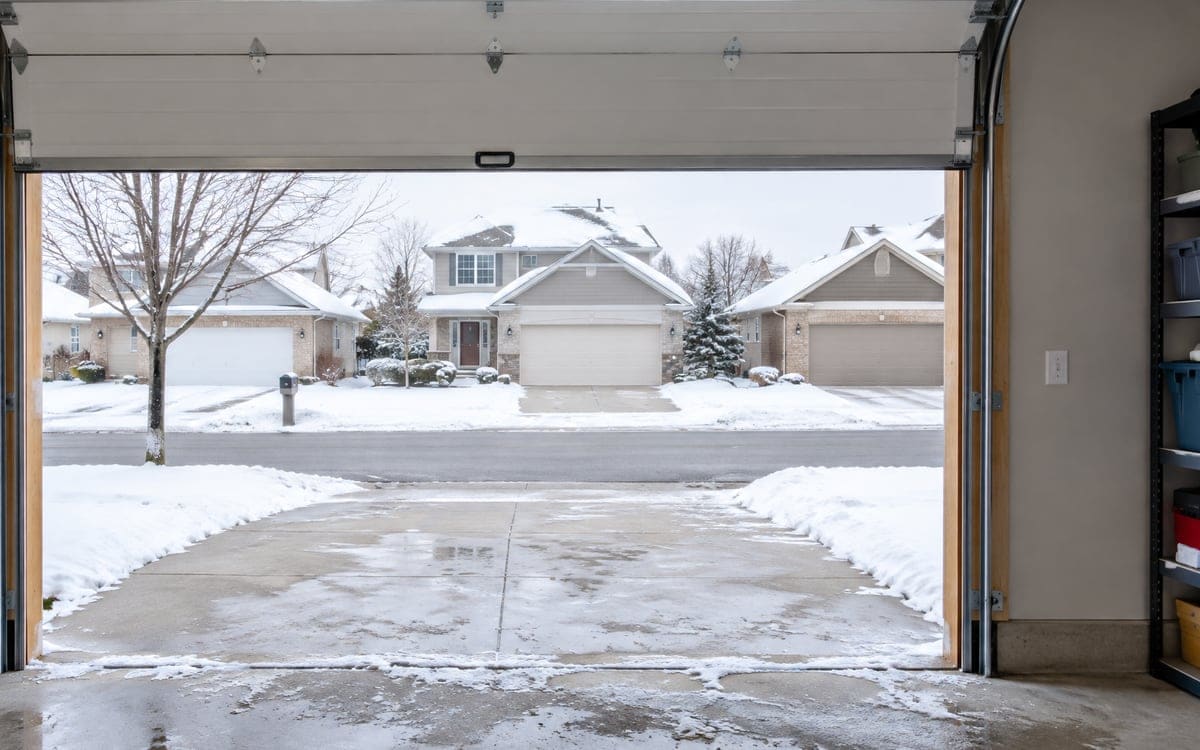
The Village's winter mix is salt and calcium chloride
The de-icer that lands on the pavement in Barrington is not plain rock salt. The Village uses a mixture of salt and calcium chloride for ice control, supplemented with a liquid de-icing material made of salt brine, calcium chloride and an organic de-icer derived from sugar beets. The residue it leaves on steel hardware is harder on metal than untreated snowmelt is.
A liquid component clings where the dry mix bounces off
The liquid piece of the mix is what makes the difference on a car's underside. Dry crystals bounce and shift on the pavement; the liquid component sticks to wheel wells, undercarriage and tires, and rides home as a thin coat rather than scattered granules. Once the car heads back home, that coating stays on it, including the parts that will sit in the garage for the rest of the day.
Public Works plows over 50 miles of Barrington street
Barrington Public Works clears snow and ice from over 50 centerline miles of Village roads and Village parking and commuter lots, aiming to clear all Village streets within 24 hours after the snow stops, using four plow routes (five in heavy snow) that put emergency and school routes first. The arterials go to other crews: state and county crews handle snow and ice on Route 14 (Northwest Highway), Ela Road, and portions of Route 59 (Hough Street). The car brings a share of whatever is on the pavement home with it.
The ridge across the driveway is where the plow leaves its load
The plow does its job on the street, which leaves a windrow across the end of the driveway. With more than 3,800 driveways in Barrington, Public Works cannot pick up the snow it pushed onto private drives, and advises residents to wait for the curb-to-curb pass before shoveling their own. That windrow is where plow slush ends up when it hits your pavement, with all of the salt and calcium chloride that was on the road baked in. The ridge sits dense and slow to melt. When the car drives over it on the way out, the car picks a lot of it up.
The curb-to-curb pass is the one worth waiting for
The Village's advice on timing is practical. Starting on the driveway before the street is open curb to curb can mean shoveling the ridge a second time once the plow finishes its work. On-street parking is generally not allowed in Barrington once 2 inches or more of snow has fallen, until snow removal is complete (the Central Business District allows parking until 1am), which keeps the street open for the plow and the driveway cleaner on the first try.
The car carries the rest of the de-icer into the garage
After the plow pass and the drive, the car's underside, tires and lower side panels are wet with brine. The car pulls into the garage, and the brine drips. On a steel door with a bottom seal that still fits, most of the mess stays on the floor. On a door with a worn seal or an uneven floor, the brine runs along the base of the door too. Over the winter, that is a lot of saltwater sitting next to steel and galvanized hardware.
Slush settles at the foot of the door
Pay attention to where meltwater pools in the garage and the pattern is easy to see. Low points near the door catch the runoff. Along the bottom seal and the lower side stops, a damp line stays wet for hours after the car dries off. The temperature outside drops back below freezing, the slush refreezes, and whatever de-icer was in the mix stays concentrated right at the hardware. That is the daily rhythm of a Barrington garage from the first measurable snow around November 18 through the last around April 2 at Chicago O'Hare, and from the first freeze through the last around April 21.
Cables and bottom brackets take the brunt first
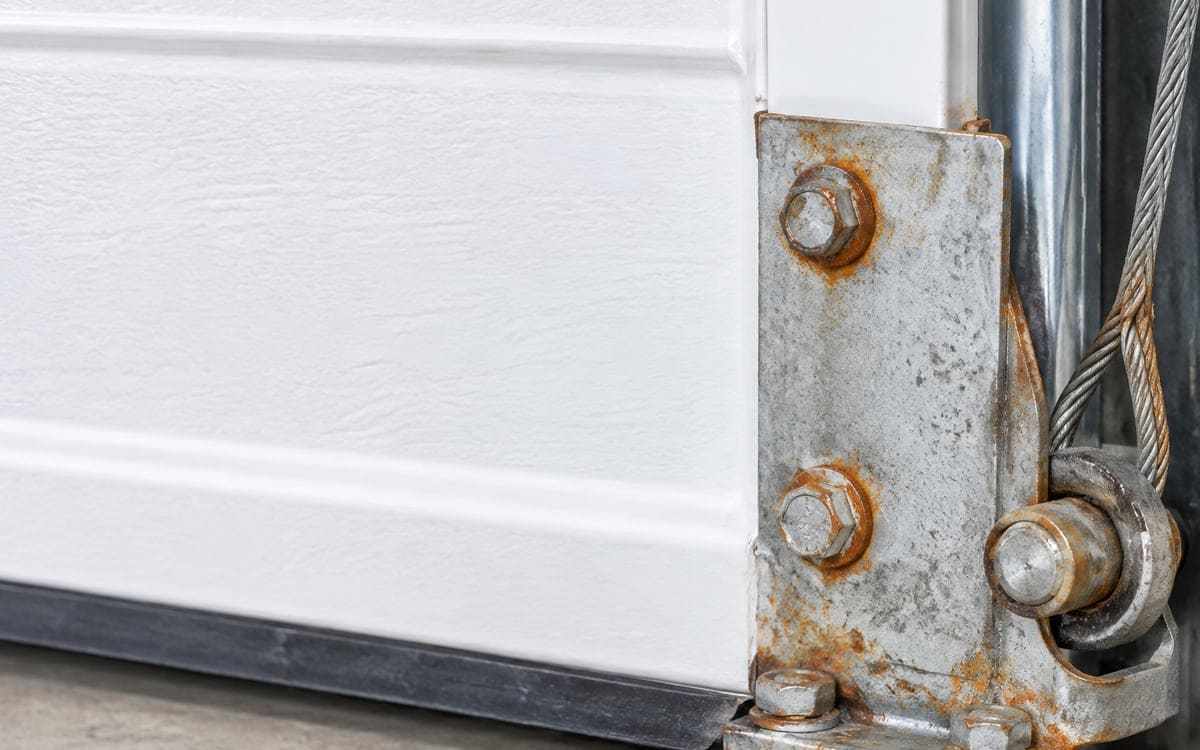
The parts closest to the floor are the ones running the highest safety load, and they are the first to show the salt. The bottom bracket at each lower corner holds the end of the lift cable under full spring tension; it is not a homeowner part, ever. On the bracket face and the bolt heads, rust starts as a brown bloom. On the cable near the bracket, the first signs are a darkening of the strands and single strands fraying. For cable and bottom bracket repair, the bracket is checked during the cable work and replaced if it is rusted.
The bottom rollers, the track and the seal are next
Walking up from the floor, the next zone is the bottom roller and the lower end of the vertical track. Rusted rollers start to drag; a wheel bearing can seize entirely after enough winters. Track rust at the floor shows up as a reddish-brown etch on the inside face where the roller runs; a mild one cleans off, a deep one eats enough of the track to put the roller onto an uneven surface. A new bottom seal and retainer is what keeps the brine off the sill; a seal that has lost its wiper lets water right through. On older doors, the retainer itself can be rusted enough that it has to come off before the seal can.
When rust gets into the section itself
Beyond the hardware, the lowest section of the door is where section-level rust shows up. On a steel door, rust usually starts on the inside bottom edge, where meltwater pools against the lower rail of the section. A thin bubble under the paint on the outside face is the next sign. By then, the metal under the paint is already pitted, and sanding and repainting is a short-term patch. For a section that is structurally gone at the bottom rail, a rusted bottom section replacement is the right fix. A full replacement comes into the picture when the model is discontinued or two sections are involved.
Where the rust lands on a Barrington garage door
| Part of the door | What the de-icer does to it | What usually fixes it |
|---|---|---|
| Bottom bracket | Brine pools at the corners, pits the bracket face and the bolt heads | Have a rusted bottom bracket looked at by a technician soon |
| Lift cable (lower end) | Lower strands darken and fray; corrosion weakens the end | Replace both cables as a pair |
| Bottom rollers | Wheel bearings pick up grit and brine, drag and eventually seize | Replace the rollers |
| Vertical track at the floor | Reddish-brown etch on the inside face where the roller runs | Clean a mild one; replace a bad section |
| Bottom seal and retainer | Loses its wiper, lets water through to the sill | Replace the seal; replace the retainer if it is soft or rusted through |
| Lowest door section | Rust starts on the inside bottom edge, bubbles under the outside paint | Replace the section; replace the door if the model is gone |
Rinse after the last snow, and leave the hardware alone
Once the measurable snow is done for the year, around April 2 at the official climate site, a bucket of warm water and a soft brush on the outside face of the door gets rid of the dried residue. Rinse the floor at the same time; the sill is where the next winter's brine would sit again. Keep hands clear of the bottom corners and all the hardware under the door. What is not a homeowner job: the cables, the bottom brackets, the springs, and any adjustment to the opener's force. Those stay with the technician on a visit. For the spring side of the same cold stretch, the spring and cold weather guide covers how springs behave through it, and the seasonal safety check guide walks through the spring look-over once salt season has ended.