About six months separate the normal first and last freezes at O'Hare
At Chicago O'Hare, the normal first autumn freeze comes on October 19, and the normal last spring freeze on April 21, based on 1991 to 2020 data. The two dates sit roughly six months apart. Over a year, northern Illinois averages 140 days a year at or below 32 degrees and 16 days at or below 0 degrees.
A door open to that air for a few seconds, a dozen times a day, is one weather barrier among several. The question is whether a thicker, insulated door shifts enough of the overall heat loss to matter in a given garage.
Insulation changes more than the temperature
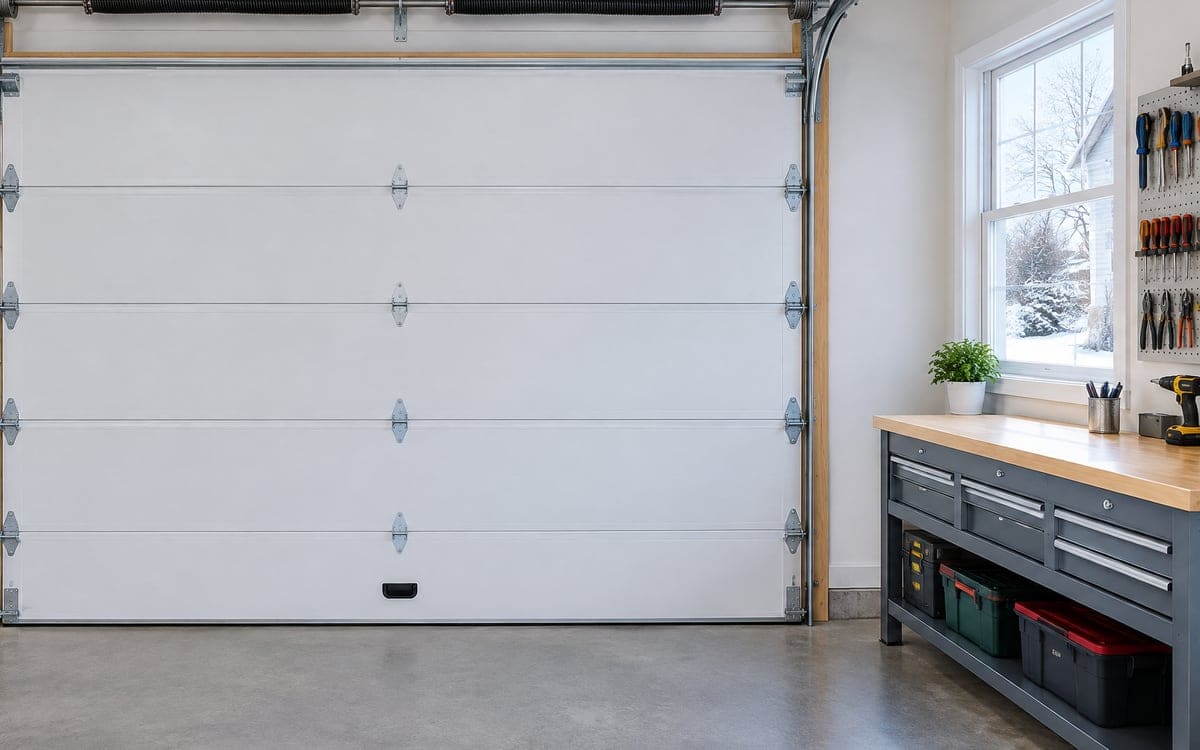
An insulated door is heavier, stiffer and quieter than a single-skin steel door of the same size. The weight comes from the foam core and the inner steel skin. The quieter run comes from the foam damping the panels, which otherwise ring when the rollers hit a track joint or the opener engages. Many homeowners notice the sound first and the warmth second.
Stiffness matters because a wide door with no insulation flexes in the middle. A flex of a quarter inch at the hinge line turns into daylight along the top and bottom when the door is closed. An insulated section holds its shape, which lets the seals do their job.
Foam cores come in two kinds
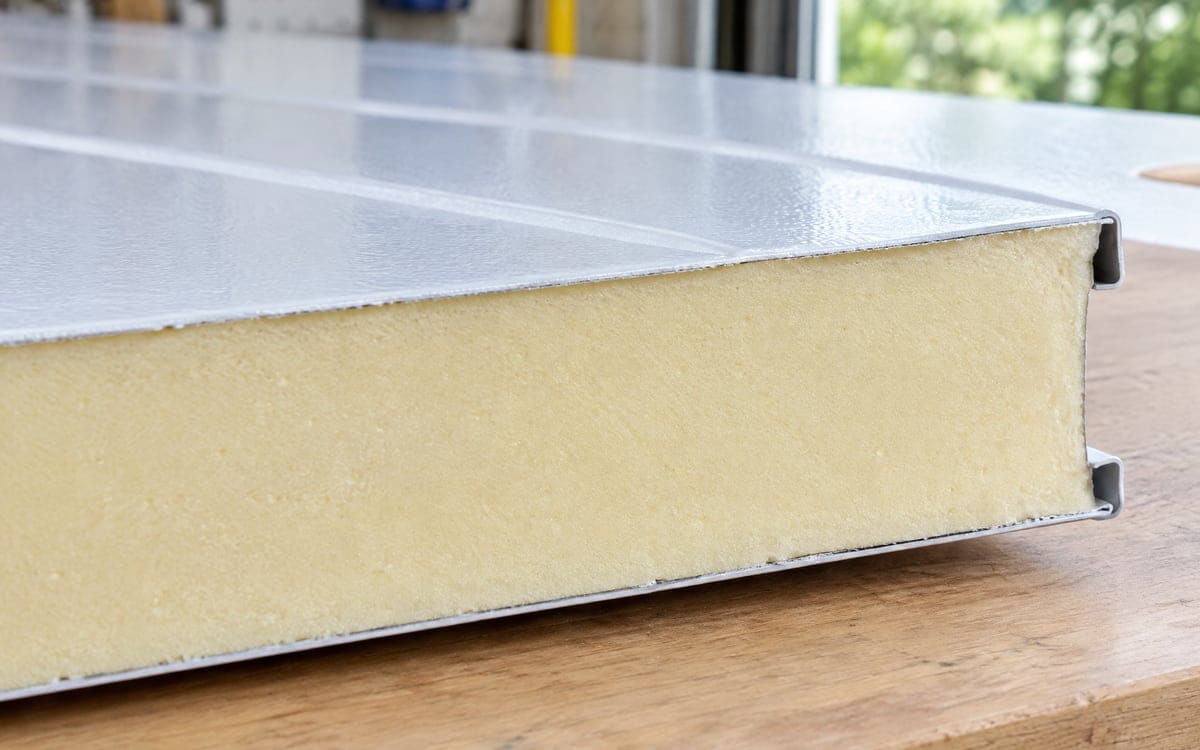
The two foam types in common use are expanded polystyrene (EPS), the same material as a picnic cooler, and polyurethane, a foam injected between the steel skins that bonds to both. EPS is cut to size and friction-fit into the door. Polyurethane fills the shell completely.
Polyurethane doors are stiffer and perform better per inch of thickness because the foam adheres to the steel. EPS doors are lighter and less expensive, and still outperform an uninsulated single skin by a wide margin. For a space that is heated, used as a workshop, or has living space above or beside it, polyurethane is usually the better choice. For a garage used only for storage, EPS can be enough.
Edges leak before panels do
Weather enters where the door meets the frame, and a new insulated door still leaks if those edges are tired. On most older garages, the seals at the sides, the top and the bottom have shrunk, split or stained the floor along the bottom corners.
The bottom seal, the astragal running along the lowest section, is the most common weak point. On an uneven slab, it can let in a line of daylight even when the rest of the door is tight. Replacing a worn bottom seal is often the first job to do, before thinking about a new insulated door.
An older garage opening leaks on its own
About 67 percent of Barrington's housing units were built before 1980. Many of those garages have wood jambs, trim boards that have shifted with the seasons, and door openings that are a little out of square. New weather stripping on a frame that has moved does not seal if the gap is uneven.
A technician works through the opening in order: the jamb trim, the top header seal, the vertical stops along the sides, and the floor at the bottom. What is worn gets replaced; what is out of true gets shimmed. A new insulated door sits inside that same opening, so the opening gets attention before the door does.
A heavier door asks for springs sized to it
An insulated door of the same size as a single-skin door can weigh noticeably more. If the springs and the opener are sized for the old weight, they will struggle from day one. Springs are the component matched to a door's weight, and the ones already on the door will not usually suit a heavier replacement.
The opener matters too. A chain opener suited to a light door can labor on a heavier one, run hot and wear out early. On an older garage with a low ceiling or a short backroom, opener installation might be a wall-mount jackshaft rather than a ceiling opener. The right choice is made with the new door in hand.
Add-on kits for an existing door have limits
Insulation kits that glue foam panels into the inside of an existing door exist, and they do something. On a thin single-skin door, they add some R-value and cut sound. What they do not do:
- Add stiffness. The foam is attached to one skin only, and the door still flexes in the middle.
- Add weight the springs are ready for. Even light panels add pounds the springs did not get a vote on.
- Seal the edges. The leak at the bottom seal is unchanged.
A kit can be the right answer in a storage garage where comfort is the only goal and the budget is small. For a workshop, a room above, or a frequent-use garage, a factory-insulated door produces a better result.
Attached and detached garages behave differently in Barrington
In Barrington village, about 68 percent of housing units are single-family detached homes, with another 9 percent single-family attached. The insulation question looks different on each.
An attached garage shares walls with the house. The door between the garage and the house is a weather barrier of its own, and the garage sits closer to the heated interior. An insulated garage door on an attached garage affects the garage air, the room above, the shared wall and the heating load behind that wall.
A detached garage with no heating has nowhere to lose heat to. An insulated door helps mostly by holding whatever warmth you add in (a space heater while you work) and by cutting the wind through the opening.
Wood and overlay doors call for a different swap
Older houses often have painted wood or wood-overlay doors on the garage. These doors look right on a mid-century ranch or a 1920s bungalow and often fail if swapped for a bare steel one. The replacement question becomes: can we match the look and still gain insulation?
The usual answer is a steel sectional door with a wood or composite overlay, insulated behind the overlay. From the driveway it reads as wood, with a stiff insulated panel behind the overlay.
For a house in Barrington's Historic Overlay District, the guidelines are specific about material. For noncontributing garages, the guidelines prefer wood, wood overlay or full composite overlay doors, and ask that the door complement the house when the house has a specific architectural style. A homeowner picking an insulated door for a district house should check with Village staff and read what the historic district guidelines ask of a garage door before ordering.
Insulation pays off most at replacement time
If an uninsulated door is already due to come off because it is dented, split, or beyond parts, a new door installation is the right moment to add insulation. The springs will be sized to the new weight, the seals will be new, and the opener's load can be checked against the door going in. If the old door is simply worn out and the opener still runs fine, replacing an uninsulated door with an insulated one is a natural swap.
If the current door runs well and the complaint is only comfort, add-on kits, better seals and a check on the opening itself are all cheaper first steps. The repair-or-replace question is worth working through before buying.
| What you want from the garage | Does insulation help | What else matters more |
|---|---|---|
| Keeping a workshop usable in winter | Yes, directly | A heat source, insulated walls, the slab |
| Keeping stored items from freezing | A little | The bottom seal and the walls |
| Cutting noise from the door | Yes, directly | Roller type and a tune up |
| Lowering the heat bill in the room above | Sometimes | The ceiling between garage and room |
| Making a thin door feel more solid | Yes, directly | Spring sizing for the new weight |