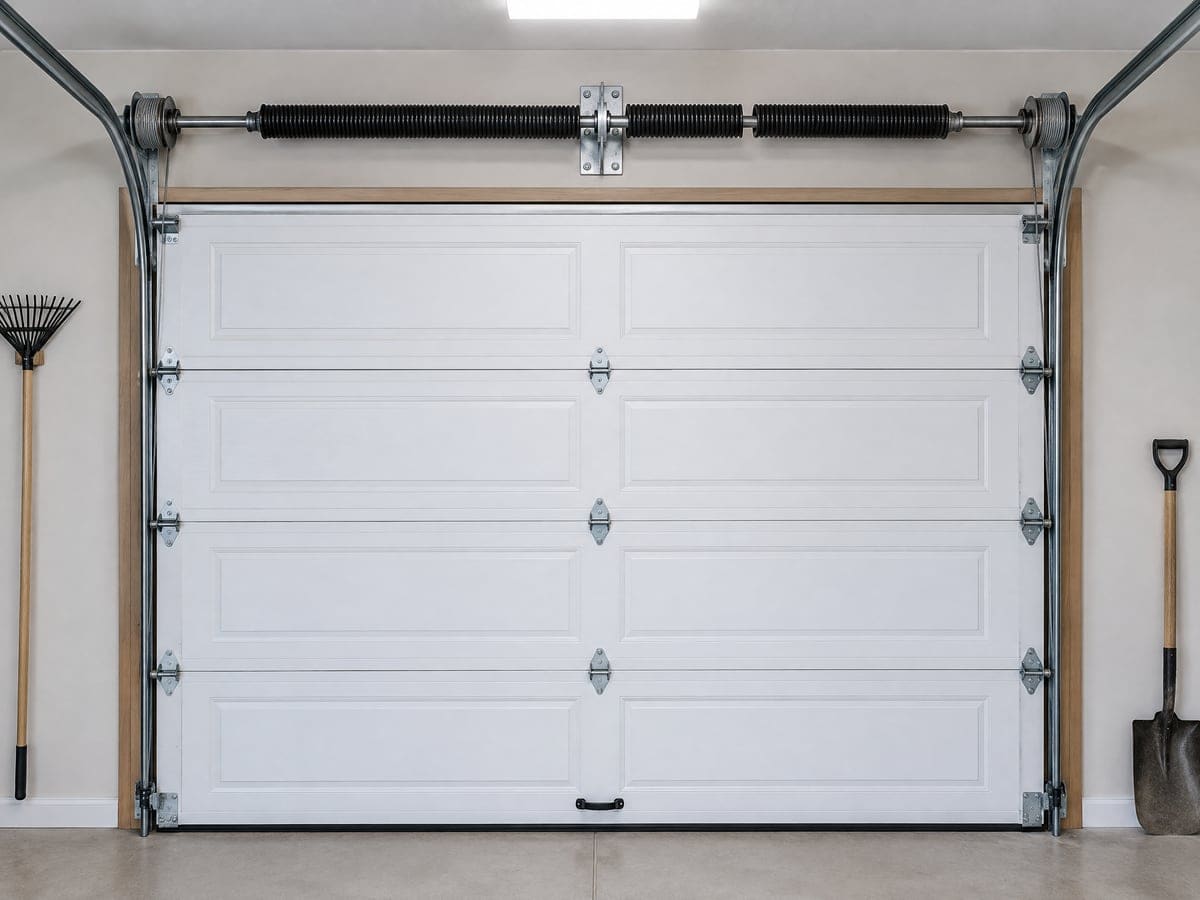
A broken spring, checked from the floor
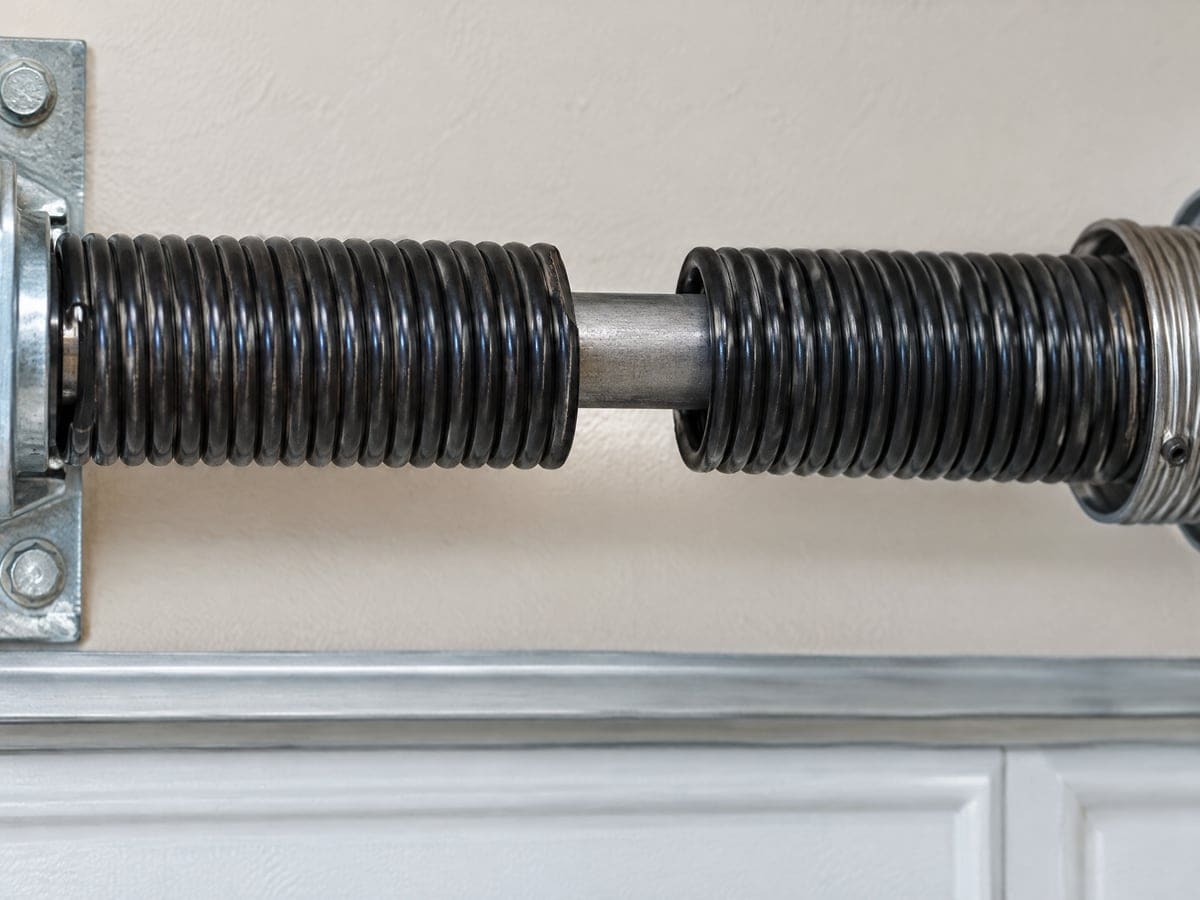
A spring that broke makes itself obvious once a technician knows where to look. Work goes floor-up with the door closed and the opener off at the panel, because the broken part is already loud enough to find without anyone touching parts that are still holding tension.
1. What the household heard and when
The first question is what you heard. A clean torsion break is a loud single bang. An extension spring letting go clatters and leaves a loose coil draped along a horizontal track. Cold mornings carry more spring breaks than warm afternoons, which shapes the follow-up checks.
2. The gap in the coil above the closed door
With the door closed, a technician looks at the spring on its shaft, or at the extension springs stretched along each horizontal track. A gap of a few inches in the coil, where the wire has pulled apart, is the plain sign. A fully intact coil on a door that opens a few inches and quits usually points to a cable off its drum, a spring that has lost its wind, or an opener force or limit setting.
3. An opener that strains, lifts a few inches and quits
If the opener was tried before the call, the next clue is what it did. A trolley that pulls the door a few inches then reverses, or an opener that hums without moving the door, both point to a spring. The opener is doing its job; the counterweight on the other side has gone, and the motor is being asked to lift the whole door on its own.
4. Slack cables or a cable off its drum
Lift cables that have gone slack at the bottom corners, or hang loose off their drums, confirm the spring call. The cables wind up as the spring unwinds, so the loss of tension on the spring side is the loss of winding on the drum side. The brackets at the bottom corners are not touched during this check.
5. Torsion or extension, one spring or two
Torsion springs sit on a shaft above the door and come as one or two depending on the door's weight and width. Extension springs run along the horizontal tracks and come as a pair, one per side. On a two-spring torsion door, the partner spring has done the same work as the one that broke, so both get replaced on the visit.
6. Extension springs and the safety cables through them
On a garage with extension springs, the second question is whether safety cables run through them. A stretched extension spring without a safety cable is a projectile when it lets go. If the cables are missing, we fit them during the repair.
Words that come up around springs
- Torsion spring: the heavy coil on a shaft above the door, which stores energy by winding
- Extension spring: a long spring on each horizontal track, which stores energy by stretching
- Cycle rating: how many open-and-close cycles a spring is built for before fatigue, expressed as a count that varies by wire size
- Winding cone: the cast fitting on each end of a torsion spring that locks the spring to the shaft while a technician winds it with bars
- Safety cable: a thin cable that threads through an extension spring so a broken spring stays on the track rather than flying across the garage
- Spring conversion: swapping an extension layout for a torsion shaft, which gives a smoother lift and a single easier-to-balance system
| Symptom | Likely cause | What it usually needs |
|---|---|---|
| Loud bang earlier, door now dead | Broken torsion spring | A pair swap, with new winding cones if the old ones are worn |
| Door lifts a few inches, then stops | Broken spring, strained opener | A pair swap and a reset of the opener force |
| Door rises crooked, one side higher | Mismatched spring tension or broken cable | A spring and cable check together |
| Extension spring stretched, no safety cable | Original 1960s or 1970s layout | A spring swap and new safety cables |
| Cable off a drum, slack at the corner | Broken spring unwound the drum | A spring plus drum reset, with new cables |
| Shaft wobble when the door runs | Worn end bearing or center bearing | A pair swap with new bearings |
Replacement, pair by pair
Springs get replaced rather than repaired. A spring that broke after a few cold mornings is at the end of its life. On a two-spring door, both get swapped so the door runs on even tension.
When we repair the spring system
- One or both springs are broken, the shaft is straight, the drums are sound and the cables are usable
- An extension layout is missing safety cables, which we add during the swap
- The door is sound, the sections are straight and the balance after the swap sits true
When a new door comes up instead
- Sections are cracked through or soft at the hinges, so a fresh spring would wear out the next hinge set
- The door's model is gone and matching parts cannot be sourced for the next repair
- Repairs have been stacking up, and a spring swap would be the fourth call on the same door
A spring break on an old door that already has a chewed-up bottom section is a point to pull up the walk-through on repair against replacement before deciding. Most of the time the answer is still a spring swap, because the rest of the door looks sound.
What a technician brings for a spring job
A spring call gets a van loaded with torsion springs in the common wire sizes and inside diameters, extension springs with safety cables, winding bars, a bearing press, end and center bearings, lift cables and drums, and the blocks and clamps that secure the door during the swap. A door with a glass-and-wood section or an uncommon spring size may need a measured second trip, and we tell you on the phone.
From the first call to a cycled door
- You call. Describe what you heard, the time of day, whether a car is inside, and anything you can see from a safe spot. A spring call has a particular sound and a particular aftermath, so a few sentences are usually enough to put the right parts on the van.
- A technician arrives, shuts the breaker off at the panel, and inspects the spring, shaft, cables and bottom brackets. The door is closed during this inspection, with no one near the drums.
- The quote and your decision. We explain the full job (the pair of springs, new cables if the cables are tired, bearings if the bearings have play, safety cables if the extension layout needs them) and give the price for each option before work starts. The call on what gets done today is yours.
- The swap and the test cycle. Torsion springs are unwound with the door closed; extension springs are swapped with the door clamped open. The old springs come off, the new springs go on with new cones, the shaft and bearings get set, and the door runs its full cycle a few times with the balance and reversal rechecked.
Cold mornings in Barrington and the springs they break
Barrington's winter is long and the housing stock is old. At Chicago O'Hare, the normal first autumn temperature of 32 degrees or lower comes on October 19, and northern Illinois averages 140 days a year at or below 32 degrees and 16 at or below 0. The median year built for housing in Barrington village is 1971, and about 67 percent of homes were built before 1980. Older garages often carry extension-spring layouts. Cold stiffens the steel and the grease, and a worn spring tends to break on the first below-freezing morning. The springs-and-winter guide walks through why.