Two dates frame the year for a Barrington garage door
At Chicago O'Hare, the normal first autumn freeze comes on October 19, and the normal last spring freeze on April 21, based on 1991 to 2020 data. Those are the dates a Barrington, Illinois homeowner can plan the two home checks around. The fall check runs before mid-October; the spring check runs after mid-April.
Before October 19: the fall look
The fall check catches problems before they become emergencies. A tired spring that managed the summer heat tends to let go on a cold November morning, when the weight of the door and the cold are both working against it. The fall look is the one that catches it in time, along with a frayed cable, a hinge section that has started to click, and a bottom seal cracked across its face.
The fall look covers: the springs above the closed door, the lift cables along the bottom corners, the rollers down each side, the hinges along the sections, the bottom seal, the sensors near the floor and the opener on the ceiling. The look is visual, done with the door closed, from the floor, at least an arm's length clear of any moving part.
The spring look comes after April 21
By the time the spring look happens, the hardware has been through five months of cold and whatever the plows have put down. Road de-icer has had six months to work on the bottom corners of the door, and shovelled snow has sat against the slab in front of the door through every freeze and thaw. About 67 percent of Barrington's housing units were built before 1980, and older garage openings carry wood jambs and softer trim that may have swelled with winter moisture.
The spring look repeats most of the fall list, and adds: rust along the bottom of the vertical tracks, salt staining at the bottom corners of the door, swelling or soft spots on wood jambs, and any new daylight along the perimeter seals. Melted and refrozen snow at the foot of the opening leaves its own marks on the bottom seal; look for cracks and torn sections. The de-icer at the foot of the door covers the chemistry side of what to look for.
The homeowner's checks stay visual
A homeowner safety check stays visual, done from a safe distance, with hands off any hardware under tension. That rules out the balance test (lifting the door after disconnecting the opener), unwinding or adjusting a spring, loosening a cable, prying on the bottom bracket, and pulling the emergency release on a door that is up or hanging. All of those are jobs for a technician on a visit.
What a homeowner may do safely: look at the parts with the door closed, listen to one full run from a safe spot inside the garage, press the wall button for the sensor and reversal checks, change the batteries in the remote and in the keypad, and check the breaker at the panel if the opener will not run. These do not call for tools or putting hands near loaded parts.
A full run watched from inside the garage
With the car out and plenty of clear floor around the door, close the door with the opener and watch the full run from the back of the garage. The door should rise and fall smoothly, without lurching at a particular height, without one side leading the other, and without extra noise at any point in the travel. The opener should carry the door without laboring.
A door that catches at the same height every run is pointing at track or a hinge at that height. One that leans to one side as it moves usually has a spring out of balance or a cable off its drum. A spring with a gap in it or a frayed cable can both show up in that one watched run.
A new noise is a signal
A squeal in rollers that used to run quietly, a grind at one spot in the track, a bang when the door hits a certain height, all are the kind of change the fall look listens for. The familiar sound of a garage door is one most homeowners stop hearing after a few months, so a change is worth catching before it gets bigger. Springs before the cold describes one of the sounds the fall check tries to catch.
Noise with no clear mechanical source is still worth noting. An opener that sounds different (louder, higher-pitched, slower) often has a worn drive gear or a tired capacitor behind it, and the sound is the first warning.
The sensor test runs from the wall button
The two photo-eye sensors near the floor on either side of the door are the opener's auto-reverse system. With the door fully open and the car and people clear of the opening, set an object the beam will catch (a cardboard box, or a cardboard tube from a paper towel roll stood on end) on the floor beside one of the sensors, in the line between the two eyes. Then step back to the wall button inside the garage, well clear of the opening, and press it. The door should refuse to close, or should start down and reverse. If it closes anyway, the sensors have failed the test. Stop using the opener and call. Sensors that fail the test often clean up with a wipe and a realignment; others need replacement.
Never stand in the door's travel path during the test. Place the object in the beam first, then operate the door from the wall button.
The reversal check uses something soft
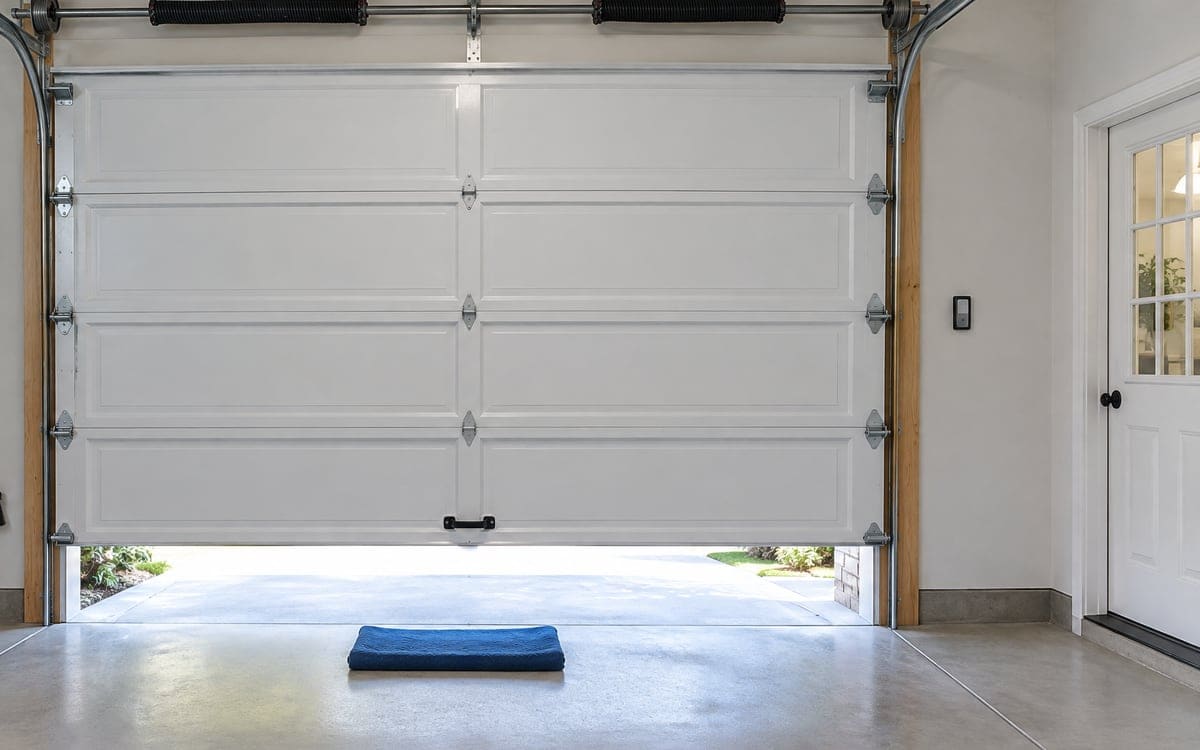
The reversal check tests the opener's downward-force cutoff. Place a soft object on the floor in the middle of the opening (a roll of paper towels or a folded towel). From the wall button, close the door. When the bottom of the door touches the soft object, the door should stop and reverse. If it does not, the opener's force or safety settings are off. Stop using the opener and call. An opener that will not reverse is a repair, and the force setting is one of the parts a homeowner should never touch.
After a snowstorm, two more things to look at
Barrington's measurable snow season runs across a long window: at Chicago O'Hare, the normal first measurable snowfall (0.1 inch or more) comes on November 18 and the normal last on April 2. After each storm, there are two extra items for the garage door.
The first is the plow ridge at the end of the driveway. The Village says there are more than 3,800 driveways in Barrington, so Public Works cannot clear snow plowed onto driveways, and recommends waiting until the street is plowed curb to curb before clearing the driveway. Clearing the ridge at the driveway's end before anyone drives over it keeps the snow from compacting into a layer that reaches the garage opening.
The second is snow or ice at the foot of the garage door. Snow and ice held against the bottom seal through a long cold spell can tear the seal or push it out of place, and daylight along the bottom when the door is closed is the sign. Clear snow back from the opening before using the opener. A torn bottom seal is a quick replacement job; the sooner it is swapped, the less meltwater reaches the floor.
What a homeowner should never adjust
| Part | Why it is off limits | What to do instead |
|---|---|---|
| Torsion or extension springs | Under full tension; a slip or a loose cone can injure | Call for spring work |
| Lift cables | Carry the springs' pull; a snap under tension is dangerous | Call for cable work |
| Bottom brackets | Hold spring tension at the bottom of the door | Call for cable or bracket work |
| Emergency release | Dropping an unbalanced door releases its weight | Leave it and call |
| Opener force or travel limits | Changing force defeats auto-reverse | Call for opener service |
| A door hanging by hand | Loaded hardware can shift suddenly | Keep clear and call |
Lubrication from the floor, a light spray on roller stems, lower hinges, and spring coils reached from below, is the only hands-on maintenance a homeowner should attempt. A ladder, a stool and a hand on a spring are not on the list.
A short written note helps the next check
Writing down what was seen on each check (any new sound, any new rust, any new daylight) takes a minute and gives the next check a baseline. A technician who comes out on a repair can also use that note to narrow the search.
For a visit that covers the parts a homeowner cannot touch, a technician's safety inspection is the paired piece. The home check catches what shows up between visits; the technician's inspection catches what the homeowner cannot see from the floor.