Working out which part failed
A repair goes faster when the fault is pinned to the right part. On a visit, we trace the problem back along the chain that moves the door: springs, cables, drums, rollers, track, sections, and the opener that pulls on all of it.
1. The closed door, with the opener's breaker off
The first move is to shut off the opener at the panel. The outlet in the ceiling sits behind an open or hanging door, so the breaker is the safer switch. With the door closed and the power out, we check the door at rest for level, flush to the floor and straight in the jamb.
2. Springs and the shaft above the door
Above the door we look at the torsion spring on its shaft or the pair of extension springs stretched along each horizontal track. A gap in the coil is the plain sign one broke. Winding cones, end bearings and the center bearing get checked for play, with no one near the drums.
3. Cables, drums and bottom brackets
Lift cables run from the bottom brackets at each corner, up the jamb and onto the cable drums at the ends of the shaft. We check each cable along its full run for fray, kink, rust and slack. The bottom brackets carry the most spring tension when the door is closed, so a technician works them with the eye only.
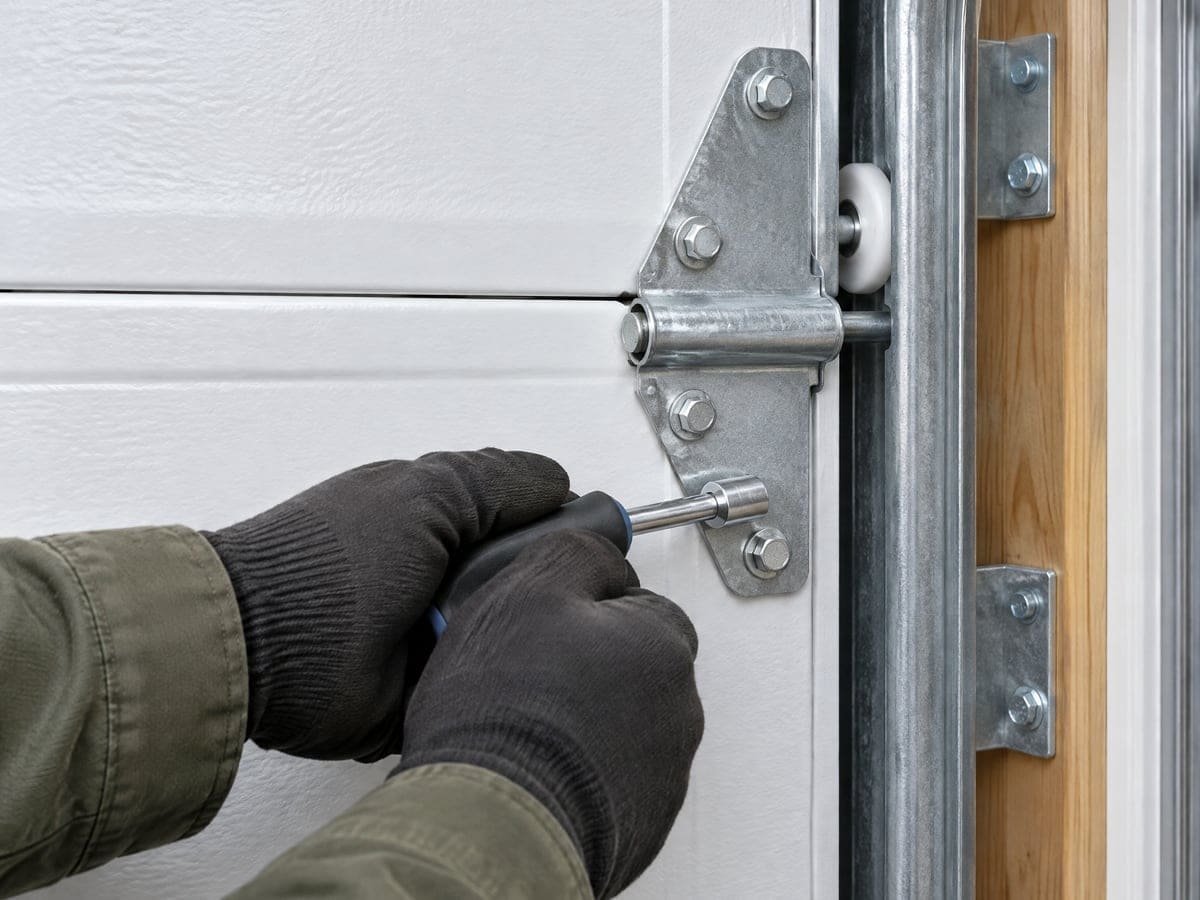
4. Rollers, hinges and the track
If the door still runs, one careful cycle shows the hinges, roller stems and sections at work; if it does not, the same check happens with the door still. Vertical tracks get sighted top to bottom. On an older Barrington garage the jamb framing is painted wood with its own history, and a loose track is as common as a bent one.
5. Sections, bottom seal and side stops
Each section gets a look along its struts and end stiles for cracks and dents. The bottom section carries the lift cables at its corners, so a hairline split there is more than cosmetic. A worn side stop or bottom seal lets daylight and salted water in.
6. Opener, rail and photo-eye sensors
The opener runs from the wall button first, then from a remote, then from a keypad if there is one. We watch the chain, belt or screw drive for slop, listen for the gear note, and sight the photo eye lenses for alignment. A door that reverses just before closing often comes back to a sensor out of line, not an opener fault.
7. The balance and reversal checks
With the opener disengaged by the technician, the door lifts to about waist height. A balanced door stays where it is left. A door that drops or rises is pulling on the opener every cycle. A block of wood under the center, then a close cycle, shows whether the reversal works.
| Symptom | Likely cause | What it usually needs |
|---|---|---|
| Loud bang, door barely moves | Broken torsion or extension spring | Torsion and extension spring repair |
| Door lifts crooked, one side low | Slack or broken lift cable | Cables and drums |
| Grinding or wobble on every run | Worn rollers or dry hinges | Rollers and hinges |
| Door hesitates at the same spot | Dent or loose bracket on the track | Track that is bent or loose |
| Door reverses just before it closes | Photo eyes out of line or dirty | The photo eyes near the floor |
| Motor hums, door does not move | Broken spring, drive gear or logic board | An opener fault |
| Daylight or meltwater at the floor | Worn or cracked bottom seal | A split bottom seal |
| Door off the track and hanging | Rollers out, cable off a drum, or impact | A door pulled out of its track |
| Loud squeal that comes and goes | Dry bearings, loose hardware | A seasonal tune up |
Repair, or sometimes a new door
One failed part on a sound door is a repair call.
When a repair is the answer
- One part has gone (a spring, a cable, a set of rollers, a sensor, a logic board) and the rest of the door looks sound
- Sections are straight, hinges hold, bottom brackets are solid, the track is close to true
- The opener, if it is the problem, has parts available and matches the door's weight
When a new door is the answer
- Sections are cracked through, soft from water, or several of them are bent
- Parts for the door's model are gone, so matching sections or hinges cannot be sourced
- Repairs have been stacking up and the balance keeps going off even after fresh springs
- The opener has no photo eyes or will not take them, and the drive is past rebuilding
The balance check and the state of the sections do most of the deciding. A door that holds its own weight on good springs, with sound hinges and panels, has years ahead of it. A door that rises crooked on fresh cables usually has a bent section or a bowed shaft that would eat the next set of parts too. The walk-through on repair against replacement lays out the lines we use at the door.
What a technician usually brings
For most visits the van carries the whole chain of parts: torsion springs in common wire sizes, extension springs with safety cables, lift cables, cable drums, bottom bracket assemblies, nylon and steel rollers in sealed and open versions, hinges numbered one through five, bottom seal in common widths, a logic board in a common footprint, photo-eye pairs, remotes and keypads. An uncommon spring size or a glass-and-wood door section may need a return trip once we have measured, and we say so on the phone.
From the phone call to the test cycle
- The phone call. You describe what the door is doing: the sound, where it stopped, whether the opener runs, any blinking light on a sensor. If you heard a bang, say so first.
- The inspection. A technician comes to the door, shuts off the breaker and runs through the fault check above. Nothing is cranked, loosened or wound during that pass.
- The quote and your go-ahead. Before any part is replaced, we explain what we found, lay out each option and give the price for each. No work starts until you say so.
- The repair and the test. The agreed work happens with the door blocked or secured as needed, then the door runs its full cycle a few times, the balance gets rechecked and the reversal gets reset.
Older Barrington garages, long cold winters
The median year built for housing in Barrington village is 1971, with about 44 percent of homes in the 1960s and 1970s together and about 13 percent built in 1939 or earlier. A garage of that age can have wood jamb framing and an extension spring layout. Northern Illinois averages 140 days a year at or below 32 degrees and 16 at or below 0, which stiffens grease and makes a tired spring break on a cold morning. On homes in the older Barrington stock, we bring longer lags and backing plates.