Use matters more than the calendar
A garage door is a mechanical system that moves a weight. Each open and close counts as a cycle. A detached garage used as the main way into the house cycles far more often than a rarely used side garage, which can take years to reach the same count. Service responds to use rather than to a date on the wall. If the door moves a lot, we look at it more often. If it moves little, less often.
Once a year works as a baseline for most Barrington homes. Fall is a reasonable time to put it on the schedule, since rollers, hinges and springs that got hot and dry in summer are the same parts that stiffen later in the year.
A long cold season adds wear
Northern Illinois averages 140 days a year at or below 32 degrees and 16 days at or below 0 degrees.1 A garage door spends a lot of its life in cold air. Our guide to springs through the cold months covers what the climate figures do and do not say about the hardware.
A door that gets a look in October has had a chance to be cleaned, inspected and lubricated before the hard months. One that gets its only look in July has to make it through winter on the condition the summer heat left it in.
Older and heavier doors need a closer look
The median year built for housing in Barrington village is 1971.2 Doors and hardware on homes of that age may be decades old. As a door type, a heavy wood door is harder on its springs, its rollers and its opener than a lighter insulated steel door, because the hardware carrying it is heavier and the panel itself is dense.
Heavier doors also mask trouble longer. An opener on a tired spring will keep lifting a wood door for a while before anything looks wrong, because the opener simply works harder on every lift. By the time it stops, parts are in worse shape than they would be on a lighter door. A shorter interval for a heavy door catches that drift.
What a Barrington homeowner checks between visits
The homeowner checks that are safe stay on the floor and off the hardware. Watch the door from inside, with the opener running. Does it travel evenly, without one side jumping? Does it close all the way to the floor on both ends? Listen for sounds that were not there a month ago: a new scrape, a chatter at one spot, a thump that lands harder than before. Look at the roller stems from the floor without touching them. Rust spots and cracked plastic rollers show from down there.
A homeowner should never pull the emergency release, in any door position, lift or hold the door by hand, or touch the springs, cables, drums or bottom brackets. The spring balance check stays with a technician.
Lubrication of the roller stems and lower hinges is a technician's task on a visit, with a product made for garage door hardware and the door closed throughout.
What a garage door safety inspection covers
A garage door safety inspection is more than a lubrication pass. On the door itself, we check the springs for coil separation, surface rust and signs of fatigue; the cables for frayed strands at the drum and the bottom bracket; the drums for alignment; the rollers for wear and cracked wheels; the end hinges that take the most twist; and the bottom seal for daylight on either end. Fasteners get checked for backing out, and the track for low screws, bent flanges and spots where the door is pressing against the vertical.
On the opener, we look at the chain or belt tension, the carriage and the stop bolt, the sensors and the wall button. If the opener has an automatic reversal, we test it with a block on the floor so the door touches the block and comes back up.
A technician also checks the spring balance on the visit. If the springs are off, the opener is doing extra work on every cycle, which shortens the life of both; the fix is new springs matched to the door's weight.
Are you supposed to get your garage door serviced on a set schedule?
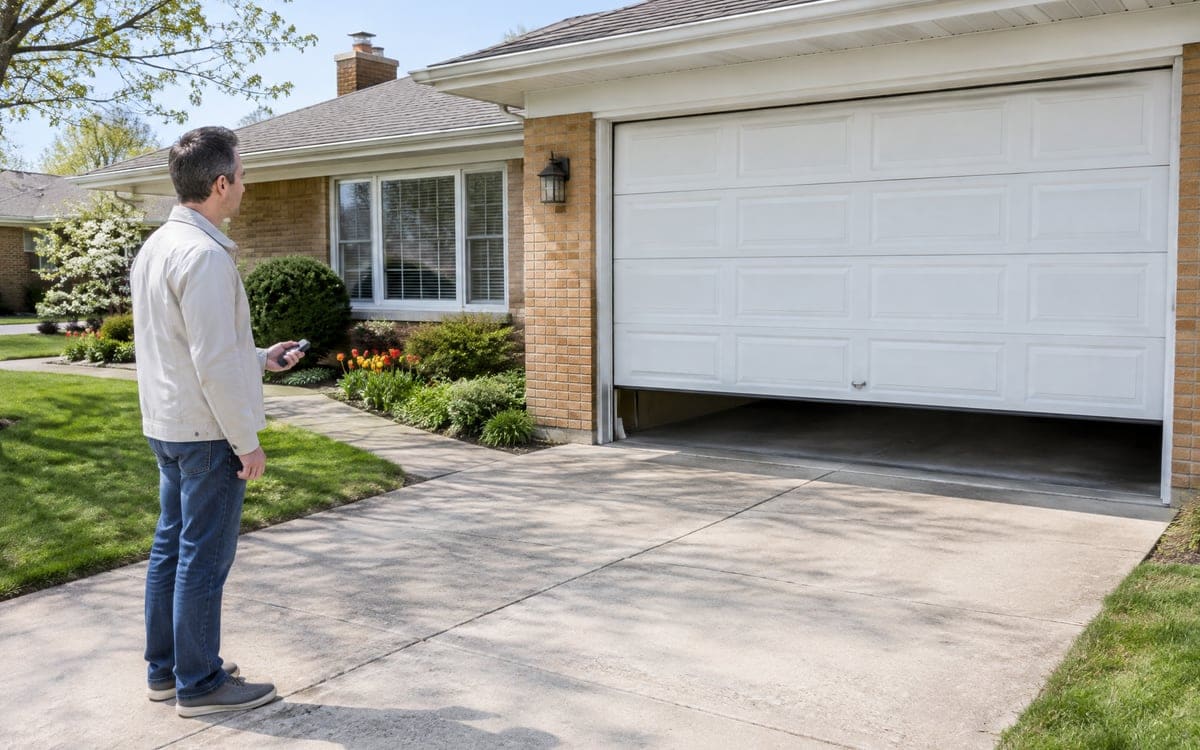
Yes. The baseline for a door used daily is a yearly look; the interval can be longer for a door that moves little and shorter for a wood door or a door in a cold detached garage. A door that is starting to make an unfamiliar sound should be looked at before it fails.
Doors on new construction get an installer check in the first year, then settle into the pattern above. A tune up on a door that gets one every year moves through fewer problems than one on a door that has not been looked at in a long time.
Signs the service is overdue
Some doors say so clearly. A metallic chatter at the top of the lift points at a roller stem running dry, while a pop as the door starts to close often means a cable is catching at the drum. If the door feels heavy to the opener and settles the last inch rather than closing smoothly, a spring is losing tension; a door that reverses after touching the floor and goes back up is usually an opener setting matter, either the down limit or the close force, rather than a part on the door.
A hum from the opener while the door does not move almost always means a broken spring; leave the door alone and call us. A stripped gear is a less common cause of the same sound. A shudder at the same spot each cycle usually comes from a bent section of track or a flat spot on a roller behind it.
What we look at on the visit
A tune up covers the parts above. The technician reads the door closed, watches a few cycles from inside with the opener running, torques the lag bolts holding the vertical track to the jamb, and tightens anything that has backed out. Hinges and rollers get checked at the pin and the stem, with worn rollers swapped out, and the bottom bracket is inspected in place. Lubrication goes on the parts that take it, with the right product in the right amount. The opener gets its own pass: force settings, limits, sensors, remotes.
If the door needs more than a tune up to be safe, our tune up and safety check sets out the extra work.
A short view of the service schedule for a typical year:
| Service item | How often | Why |
|---|---|---|
| Visual check from the floor | Monthly | Catches new sounds and obvious wear |
| Full tune up and safety check | Yearly | A technician looks at every part |
| A second look | Heavy or heavily used doors | Catches early wear before it compounds |