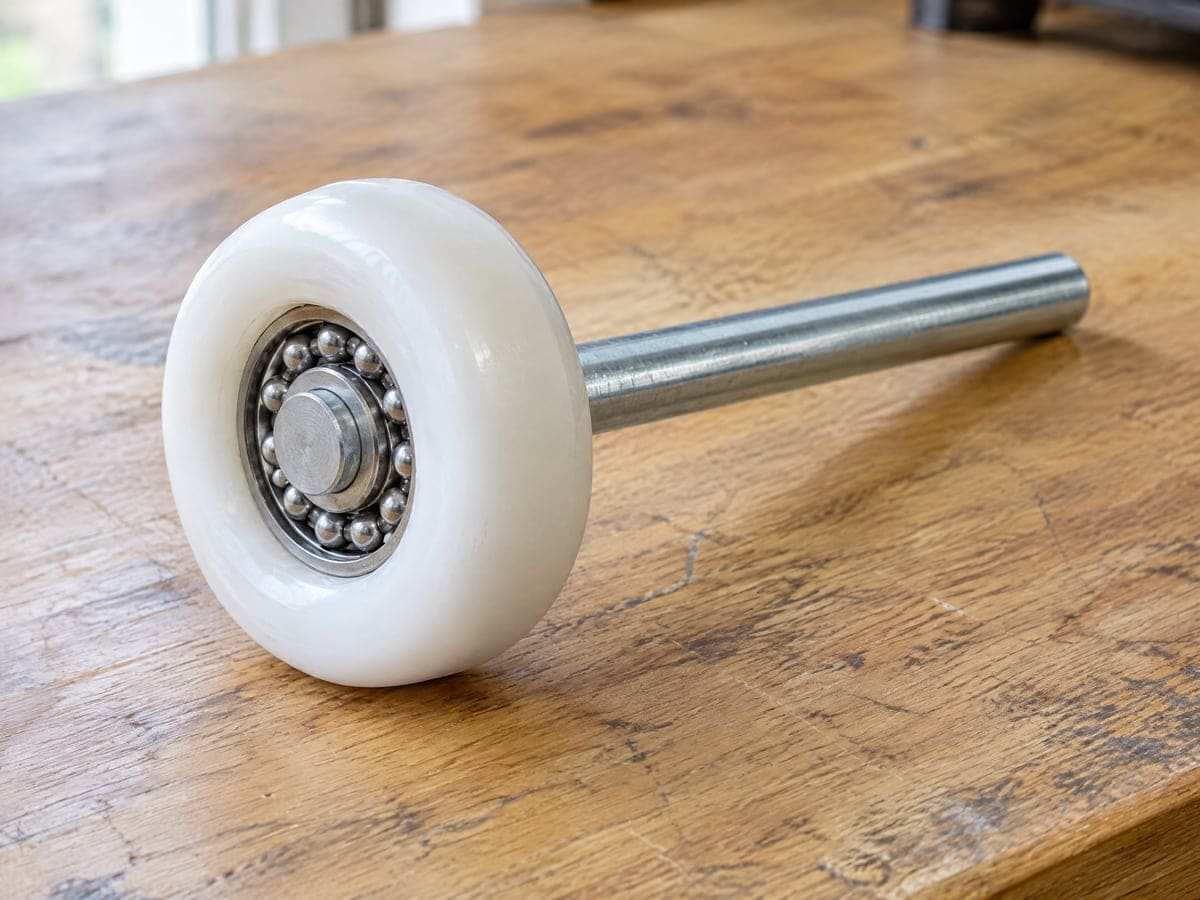
Checking a loud door from the side
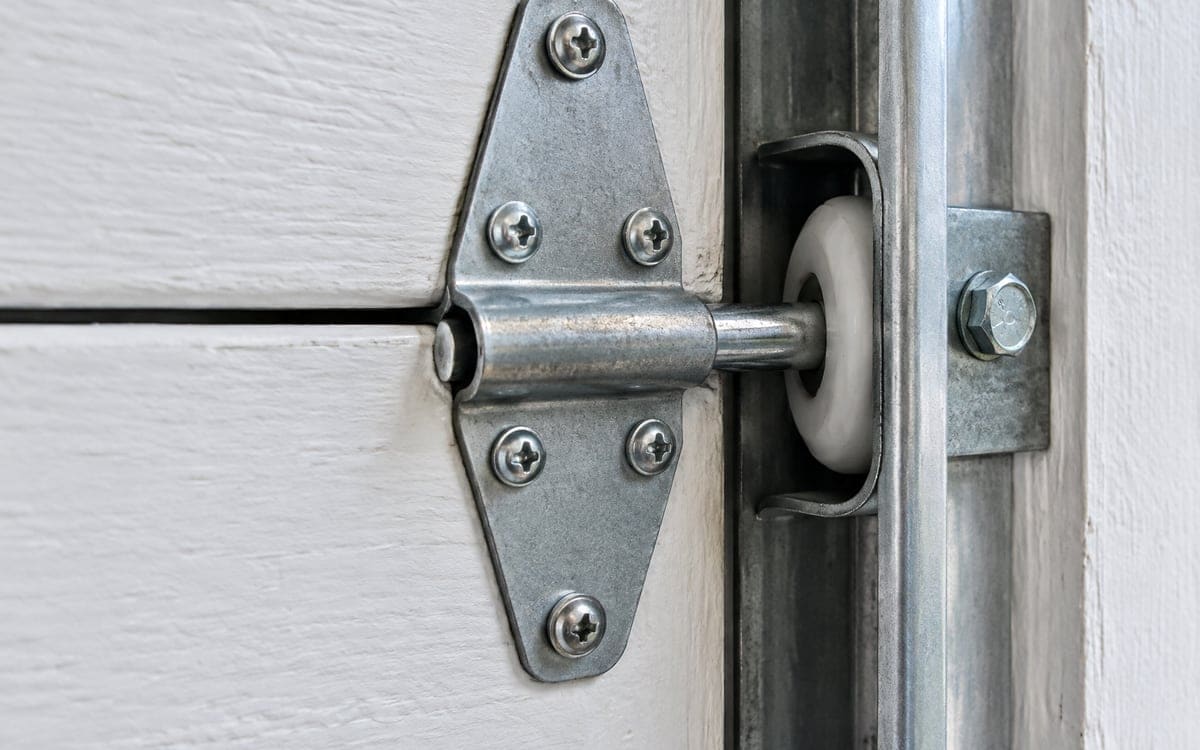
Rollers show their age at the sides of the door, not from the front. A technician watches one careful cycle from the side when it is safe to run, listens along each track, and then stops the door for a close look.
1. Watching one full run of the door
If the door is safe to run (balance holds, no cable issue, no spring break), one careful open-and-close shows the rollers at work. Wobble at a specific hinge, a wheel that is skidding instead of rolling, or a jump as a wheel crosses a track seam are each visible from the side. If the door is not safe to run, we go straight to the still check.
2. Flat spots, cracked wheels and bent stems
A roller that has been skidding has flat spots on the wheel. A cracked nylon wheel shows a hairline on the rim. A bent stem is visible as a wheel that sits a half degree off plumb in its hinge tube. Each of those is a replacement, and most of the time one worn roller means the whole set is at the same age.
3. The hinges that hold the rollers, and the screws in older or wood sections
The hinge tube that cradles the roller stem screws into the top edge of each section. On an older Barrington garage with wood sections, the screw holes are often reamed out, so a new hinge gets fresh screws or moves to a backing plate. A hinge that is pulling out of a section is a reason to look at the whole hinge line, not just the roller it carries.
4. Listening along each track
With the door still, we tap the track lightly and run a finger along the inside of the channel. Burrs from a dented track chew up a wheel. Grit held in the brine from the floor polishes the inside face of the channel to a bright finish on one side and leaves a dull line on the other. Both of those are reasons to swap the roller set at a particular hinge.
5. The bottom roller brackets, which hold spring tension
The bottom rollers sit in the bottom brackets, which carry the most spring tension when the door is closed. The bottom roller swap goes with a cable job, not a hinge job, and never with a homeowner's hand. A sound bottom bracket with a cracked bottom roller still means the door comes down under support before the swap.
Nylon or steel, sealed or open
- Nylon roller: a polymer wheel on a steel stem, quiet when the bearings are good, kinder to the track on an older garage
- Steel roller: a metal wheel on a steel stem, longer-lived under load, louder as it ages
- Sealed bearing: a bearing with its grease held in by a shield at each face, which keeps dirt out but is harder to re-lubricate
- Open bearing: a bearing exposed on both faces, which takes a spray from the floor but also takes in grit from a dirty track
- Stem: the shaft that passes through the hinge tube and carries the wheel on the other side
- Hinge number: a marking on each hinge that puts it in its right spot on the door; the top hinges and the bottom hinges are not the same part
| Symptom | Likely cause | What it usually needs |
|---|---|---|
| Grinding or buzz on every run | Worn bearings or dry hinges | A full roller swap, with hinges rechecked |
| Wobble or shake at one section | Cracked wheel or bent stem | A roller swap at that hinge, plus a look at the neighbors |
| Flat spots on the wheels | Rollers that have been skidding | A full roller swap and a track clean |
| Rust and squeal in cold weather | Water and brine at the stems | A nylon-with-sealed-bearing swap and a bottom-seal check |
| Door jumps in the track | A dent in the track, a worn hinge | A track inspection with the roller swap |
| Hinge pulling out of a section | Screw holes reamed in older wood | New hinge with backing plates, roller as a pair |
A set of rollers, sometimes with hinges and track
A roller swap is one of the cleaner Barrington repairs. The whole set gets replaced together, because a single new wheel next to seven old ones puts the mismatch at the hinge where the new one lives. The question that comes with the roller swap is whether the hinges and the track need work too.
When a roller swap stands on its own
- Rollers are at the end of their life but hinges hold true and the track sits straight
- Noise is new and no sections are bent at the hinge line
- The bottom brackets look sound, so no spring or cable work has to come with the job
When the roller swap gets company
- Hinges are pulling out of older wood sections, so hinges and backing plates come with the rollers
- The track has a kink that would chew up a new roller inside the first season, so a track repair joins the job
- A broken cable or a bowed shaft put the door off its channel, so the cable work is first
Parts a technician usually brings
A roller call gets a van loaded with full roller sets in nylon with sealed bearings, steel rollers for doors that have run on them for years, hinges numbered one through five, backing plates for older wood sections, lag and sheet-metal screws in the common sizes, a drift to tap out a stuck stem, and the clamps that hold a section at a sensible height during the swap. An unusual roller size may need a second trip once the hinge has been measured.
On the day of a roller job
- You call. Describe the sound (buzz, grind, pop at one spot) and when it started. A roller call sounds different from a spring call or a track call, and the sentence or two over the phone usually tells us what to bring.
- A technician arrives, shuts off the breaker, watches one run if the door is safe, then checks the hinges, rollers and track from the side with the door closed.
- The price for each piece. We price the roller swap on its own, then any hinges and track work that need to go with it, and explain each option. Nothing is swapped until the price is agreed.
- The swap and the test cycle. The door comes down under support where any bottom work is needed, the rollers go in from the top hinge down, the hinges get retightened, the track gets rechecked, and the door runs its full cycle a few times.
Rust at the roller stems, the Barrington version
The Village streets are cleared with salt and calcium chloride and a liquid de-icer of salt brine, calcium chloride and Geomelt, and that mixture rides into the garage on the tires every winter day. Northern Illinois averages 140 days a year at or below 32 degrees and 16 at or below 0, so the slush at the floor sits for weeks instead of drying off between storms. The roller stems at the bottom of the door live right in that puddle. With the median year built for housing in Barrington village at 1971, a lot of garages here have been through a few cold seasons already, and the choice between an open-bearing steel and a sealed-bearing nylon is worth a minute at the kitchen table. What the road salt does to a door's hardware is the longer guide.